
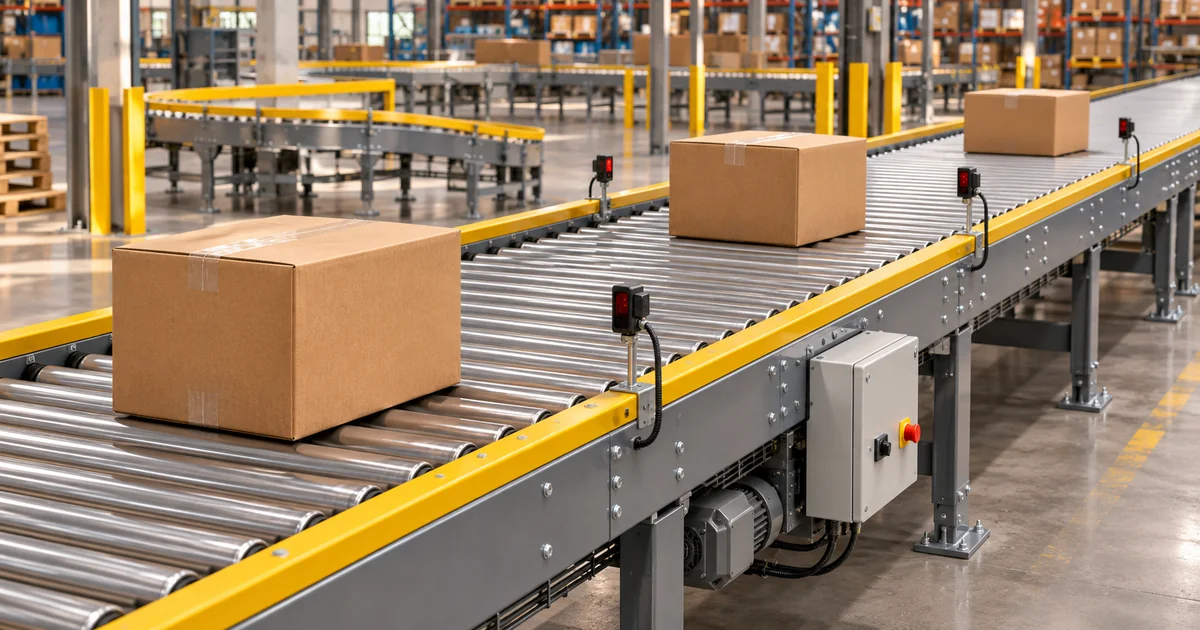
Powered roller conveyor accumulation is not simply a matter of stopping cartons on a moving line. A useful accumulation design gives each load a predictable place to wait, prevents the next load from pushing into it, and releases the queue at a rate the downstream equipment can accept. For a fulfillment or parcel operation, the design should start with the real package mix and the behavior of the entire line, not a catalog speed alone.
GSSort’s powered roller conveyor page lists accumulation, including zero-pressure accumulation, as an optional function. That matters: a standard transport conveyor is not automatically a zoned accumulation conveyor. The controls, sensors, drives, zone lengths, and downstream handshake must be specified for the project. This guide explains what to ask for before approving a layout or quote.
What Is Powered Roller Conveyor Accumulation?
Accumulation lets loads pause on a conveyor while a downstream machine, sorter, operator, or transfer point is unavailable. The MHI conveyor overview distinguishes powered conveyors from gravity conveyors and identifies non-contact, minimum-pressure, and zero-pressure accumulation approaches. In a zero-pressure design, the intent is to hold loads without one carton pushing against the next. The specific control method still varies by equipment and application.
For carton handling, a typical concept divides the line into individually controlled zones. A sensor detects a carton in a zone; a control signal stops or starts that zone according to the state of the adjacent zone. When the downstream path becomes available, loads are released in a controlled sequence. This is a design pattern, not a claim that every powered roller section has the same hardware or software.
Start With the Loads, Not the Roller Speed
Before discussing zone length, document the items that will actually travel on the line. Record the minimum and maximum footprint, weight, base rigidity, packaging type, center of gravity, and the orientation in which items enter. A rigid carton or tote may run predictably on rollers; a soft mailer, uneven base, loose strap, or damaged carton may not. Decide whether such items are accepted, need a different conveying surface, or require an exception path.
Test the smallest stable-base item against the proposed roller pitch. Its base must remain supported during travel and at transfers. Also test the longest load against the proposed zone arrangement. A load that bridges two zones changes the sensor and release logic. Do not derive a universal zone length from a single carton dimension; the final value depends on the accepted package range, stopping distance, sensor placement, and desired gap.
If the main question is whether a powered line is needed at all, read our gravity vs powered roller conveyor comparison first. The present article addresses the more specific problem of queuing loads on a powered line.
Map Every Place a Queue Can Form
Draw the full route from induction to discharge and mark each device that can interrupt flow: scanners, weigh scales, merges, divert points, sorters, packing stations, and manual work areas. Accumulation may be needed before a bottleneck, but adding holding zones in the wrong place can simply move the jam upstream. For each stop point, answer four questions:
- What signal means the downstream equipment is ready to receive the next load?
- How many loads must the line hold during a normal pause and a realistic surge?
- Where does the upstream equipment stop or divert when all available zones are full?
- How does the line restart without releasing cartons too closely together?
Calculate holding capacity from usable zones and the accepted load mix rather than from conveyor length alone. A line that holds many short cartons may hold far fewer long ones. Include curves, transfers, and maintenance access in the layout; not every section is suitable for storage.
Specify Sensors and Zone Control Together
A sensor is useful only if it detects the real range of loads at the right point. Ask the integrator to show the sensing position for short cartons, dark or reflective packaging, low-profile items, and cartons that are skewed. Define what happens when a sensor remains blocked, fails to detect a load, or reports an impossible sequence. A full-zone signal should lead to a safe upstream response, not an uncontrolled pile-up.
For each controlled zone, confirm whether its drive can stop independently, how braking or coast-down is handled, and how the controller decides that the next zone is clear. Request a control narrative covering normal accumulation, release, emergency stop, power recovery, jam detection, and manual clearing. Confirm the required interfaces with the line PLC, sorter, warehouse control system, or other equipment; a powered roller section should not be assumed to provide every interface by default.
Choose the Release Pattern for the Downstream Process
Release logic is not just about maximizing the number of cartons in motion. A scanner may need consistent spacing, a merge may need gaps, and a sorter may have an induction window. Agree on the required gap at the receiving device, then validate it with the fastest and slowest approved loads. A release pattern that works with uniform boxes may be unreliable with a mixed carton population.
Review the transition from accumulation to the next device. Check roller-to-belt or roller-to-sorter height, gap, load orientation, and the effect of a sudden downstream stop. Where a conveyor joins a larger fulfillment line, the e-commerce fulfillment conveyor guide provides broader context for selecting and connecting equipment.
Include Safety, Access, and Recovery in the Layout
Accumulated loads can hide pinch points and tempt operators to reach into a moving line. Guarding, emergency-stop coverage, lockout procedures, access routes, and jam-clearing instructions belong in the design review. MHI describes conveyors as fixed-path material-handling equipment, but a fixed path does not eliminate hazards at rollers, drives, transfers, and access points. Apply the requirements of the installation jurisdiction and the site’s own safety process.
Ask how the system behaves after an emergency stop or power loss. It should not restart in a way that surprises an operator or sends a tightly packed queue into an unavailable sorter. The acceptance test should include a controlled restart with occupied zones, not only an empty-line demonstration.
Run an Acceptance Test With Realistic Cartons
A short demonstration with identical sample cartons cannot establish sustained performance. Build a trial set containing the smallest accepted carton, the longest carton, the heaviest load, the lightest load, and any packaging that challenges detection or roller support. Test at the planned operating speed and with the actual or representative downstream handshake.
- Fill the available zones and confirm that upstream feeding stops or diverts as designed.
- Pause and restart the downstream device repeatedly, including at peak arrival rate.
- Check contact, scuffing, skew, tipping, and unintended movement while cartons wait.
- Measure the delivered gap and sustained output at the receiving device.
- Test blocked or missed sensor scenarios and verify alarms and recovery steps.
- Record the accepted load mix, intervention count, test duration, and pass criteria.
Throughput should be stated for those test conditions. A nominal conveyor speed or brief burst rate does not prove the whole line can deliver the same number of cartons every hour.
What to Include in a Powered Roller Conveyor RFQ
Send the supplier a floor plan, load range, package photos, target average and peak flow, surge duration, available power, required interfaces, and the location of each downstream constraint. Ask for a drawing that marks the transport sections, accumulation zones, sensors, drives, guards, access points, and transfers. Request the control narrative and a documented acceptance plan alongside the mechanical quotation.
GSSort lists configurable drive, frame, speed, and control options on its powered roller conveyor page. Treat any published range as a product-family description, not a guarantee that one configuration suits your loads or throughput. Confirm the exact build and optional zero-pressure accumulation function in the project proposal.
Frequently Asked Questions
Is every powered roller conveyor a zero-pressure accumulation conveyor?
No. Powered transport and zero-pressure accumulation are different functions. GSSort lists zero-pressure accumulation as an optional feature; confirm the required zone drives, sensing, controls, and interfaces in the quoted configuration.
How long should an accumulation zone be?
There is no universal length. Size zones around the accepted load dimensions, stopping behavior, sensor position, and release gap, then test both the shortest and longest loads. A long carton bridging zones may require different logic from a short carton.
Can soft poly mailers use a roller accumulation line?
Do not assume so. Flexible packages may sag between rollers or be difficult to detect consistently. Test representative mailers on the proposed roller pitch and sensors, or evaluate another conveying surface for that part of the flow.
Does adding more zones always increase throughput?
No. More zones can provide more temporary holding space, but sustained throughput is limited by induction, merges, scanners, sorting, packing, and other downstream processes. Measure the complete line under a realistic load mix.
Plan the Queue Before It Reaches the Sorter
Powered roller conveyor accumulation works best when the queue location, load range, stop-and-release behavior, and downstream interface are defined together. Contact GSSort with your carton data and line layout to discuss whether a configured powered roller solution with optional accumulation fits your operation.