
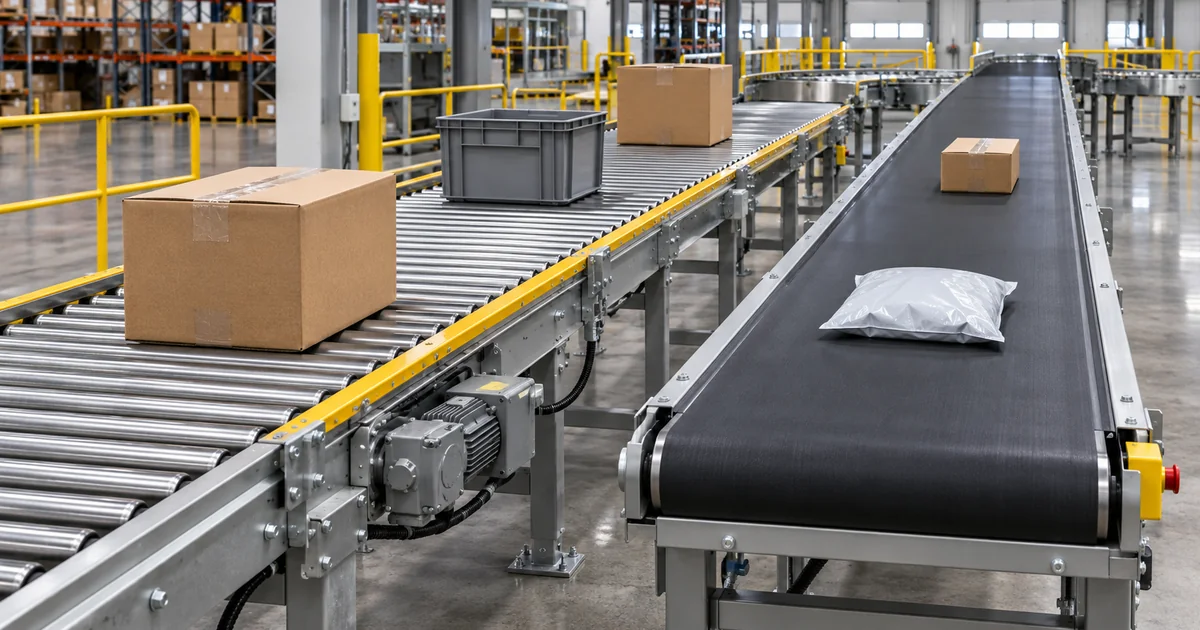
A powered roller conveyor vs belt conveyor decision begins with what touches the parcel. Powered rollers move a stable-base load over a series of rotating cylinders. A belt carries the load on a continuous moving surface. Both can be motor-driven, and either can be part of an automated warehouse line, but they respond differently to small bases, soft packaging, accumulation, transfers, and maintenance.
GSSort offers a powered roller conveyor for cartons, totes, boxes, and other flat-bottom items, and a straight belt conveyor for a broader package mix that its product page says can include cartons, totes, and bags. Those descriptions are a starting point, not proof that every item in your operation will run reliably. Use actual parcels and a complete line drawing to make the choice.
Powered Roller Conveyor vs Belt Conveyor: The Basic Difference
The MHI conveyor overview describes live roller conveyors as moving loads on powered rollers and belt conveyors as transporting loads on a moving belt. The key selection issue is the contact surface: spaced rollers versus a continuous surface. Neither type is universally faster, cheaper, or gentler. Those outcomes depend on the selected equipment, package mix, control scheme, and interfaces.
| Decision point | Powered roller conveyor | Straight belt conveyor |
|---|---|---|
| Load support | Multiple rollers contact the bottom of the load | A continuous belt supports the bottom |
| Good starting trial | Rigid, flat-bottom cartons and totes | Mixed cartons plus soft or small-base items needing continuous support |
| Critical check | Can the smallest item bridge the roller pitch without tipping or catching? | Will the item track, transfer, and discharge reliably on the proposed belt? |
| Accumulation | Optional zoned or zero-pressure configuration must be specified | Requires a suitable control and mechanical design; do not assume a basic transport belt accumulates safely |
| Maintenance focus | Rollers, drives, sensors, and zone controls | Belt tracking, tension, wear, drive, and cleaning access |
This is a design checklist rather than a universal capacity comparison. Obtain equipment-specific drawings and test data before ranking alternatives by throughput or cost.
Start With the Package Base and Smallest Item
List the minimum and maximum length, width, height, and weight of every accepted item. Note whether the base is rigid and flat, bowed, soft, ribbed, strapped, or partly open. Record the lowest-filled carton, the lightest poly mailer, and any bag with a loose edge. The least stable approved item often drives the design more than the average carton.
For rollers, check the proposed roller pitch against the shortest contact length and test at transfers and curves. A load should remain adequately supported as it moves from roller to roller. A soft mailer may sag or catch between rollers; a narrow box may skew. These are reasons to test, not automatic disqualifications for every roller design.
A belt removes the open gaps between rollers, but a continuous surface does not solve every package problem. Light bags may shift, sticky packaging may drag, and a poorly designed transfer gap can still snag an edge. Include representative damaged and irregular packages in the trial, not only clean sample boxes.
Match the Conveyor to the Flow Pattern
Ask whether the line is mainly moving a steady stream or regularly stopping ahead of scanners, merges, sorting equipment, and packing stations. GSSort lists zero-pressure accumulation as an optional powered roller feature. If loads must queue without pushing into one another, specify the zone drives, sensors, release sequence, and upstream stop signal. Our powered roller accumulation checklist goes through those design inputs in detail.
A belt line can also be controlled to stop, meter, or buffer products, but a simple continuously running belt is not a substitute for an engineered accumulation system. Ask where parcels may wait and what happens when the downstream device becomes unavailable. Avoid comparing a fully zoned roller system with an unzoned belt on price alone; they are solving different problems.
If the project does not require positive powered transport, first consider whether a gravity section fits the route. Our gravity vs powered roller conveyor guide addresses that separate decision. This article compares two powered conveying surfaces.
Check Transfers, Scanners, and Sorter Induction
A conveyor rarely operates alone. Map the upstream feed and downstream takeaway, including every right-angle transfer, curve, scanner, scale, and sorter induction. The selected surface must deliver the load in the right orientation and with the right gap for the next machine.
For a roller line, inspect transitions where a small carton or tote crosses a gap, especially at a change in direction or elevation. For a belt line, inspect the nose or transfer geometry and confirm that the smallest or softest approved item does not snag. Neither a roller nor a belt specification on its own proves that the complete interface will work.
When a scanner or sorter needs repeatable spacing, define the required gap at that device and test it with both short and long packages. A stated conveyor speed is not equivalent to sustained line throughput; the merge, scan, sort, and discharge stages can become the limiting step.
Compare Maintenance and Operating Conditions
Rollers and belts have different maintenance points. Ask for access to rollers, drives, sensors, and zone controllers on a powered roller system. On a belt system, review belt tracking, tensioning, cleaning, replacement access, and the effect of debris or damaged packaging. For both, check guarding, emergency stops, jam-clearing access, and safe restart behavior.
Consider the actual environment: dust, moisture, temperature, washdown needs, and expected operating hours. GSSort publishes material and control options for both product families, but the exact configuration should be confirmed in the quotation. Do not assume that a generic published speed or load range applies to every width, belt material, roller drive, or package mix.
Build a Representative Acceptance Trial
Before approving either layout, agree on a test set and pass criteria. Include the lightest and heaviest accepted loads, the smallest base, the longest carton, a soft bag if allowed, and packages with realistic seams or wear. Run them at the intended arrival rate and through the planned transfers.
- Support: check for sagging, tipping, skew, or catching on the conveying surface.
- Transfer: verify smooth entry and exit at each conveyor interface.
- Flow: measure delivered gap and sustained output at the downstream device, not only belt or roller speed.
- Stops: pause the downstream machine and observe where the queue forms and how it restarts.
- Condition: inspect for scuffing, crushed corners, belt marks, or damaged packaging.
- Recovery: test a jam and a controlled restart with the line occupied.
Record the parcel mix, test duration, intervention count, and conditions under which the claimed throughput was measured. A trial with one ideal carton cannot validate a mixed-parcel operation.
What to Send for a Quote
Give the supplier package dimensions and weights, photos of the least stable items, average and peak hourly arrivals, surge duration, line drawing, available footprint, power, and required interfaces. State whether accumulation, scanning, merging, or sorter induction is required. Ask for a proposed roller pitch or belt and transfer specification, maintenance access, controls narrative, and acceptance plan.
If the route includes soft mailers and cartons, request a test with both, rather than assuming one surface is automatically best. If the line mostly carries stable cartons but needs controlled queueing, ask for the optional accumulation configuration and its limits. A hybrid line can also be valid: use the surface that fits each section and engineer the transition between them.
Frequently Asked Questions
Is a powered roller conveyor better than a belt conveyor for cartons?
Not in every project. Rigid, flat-bottom cartons are a sensible starting point for rollers, while a belt provides a continuous contact surface. The right choice depends on the smallest item, accumulation need, transfers, operating conditions, and tested line performance.
Can a powered roller conveyor carry poly mailers?
Do not assume it can. A soft mailer may sag between rollers or behave unpredictably at transfers. Test the real mailer range against the proposed roller pitch, sensors, and line geometry before including it in the accepted mix.
Which conveyor handles accumulation better?
It depends on the configuration. GSSort lists optional zero-pressure accumulation for its powered roller product. A belt system can also be engineered for controlled stopping and release, but neither basic transport line should be assumed to accumulate safely without a defined design.
Which option has higher throughput?
Neither surface has a universal advantage. Compare sustained output with the same package mix, feed pattern, transfer geometry, and downstream equipment. The receiving machine may limit the whole system before either conveyor reaches its nominal speed.
Choose the Surface From Your Real Parcel Flow
The powered roller conveyor vs belt conveyor decision should follow a representative package trial and a drawing of the complete line. Contact GSSort with your parcel range, layout, and target flow to review a powered roller, straight belt, or mixed conveyor solution.