
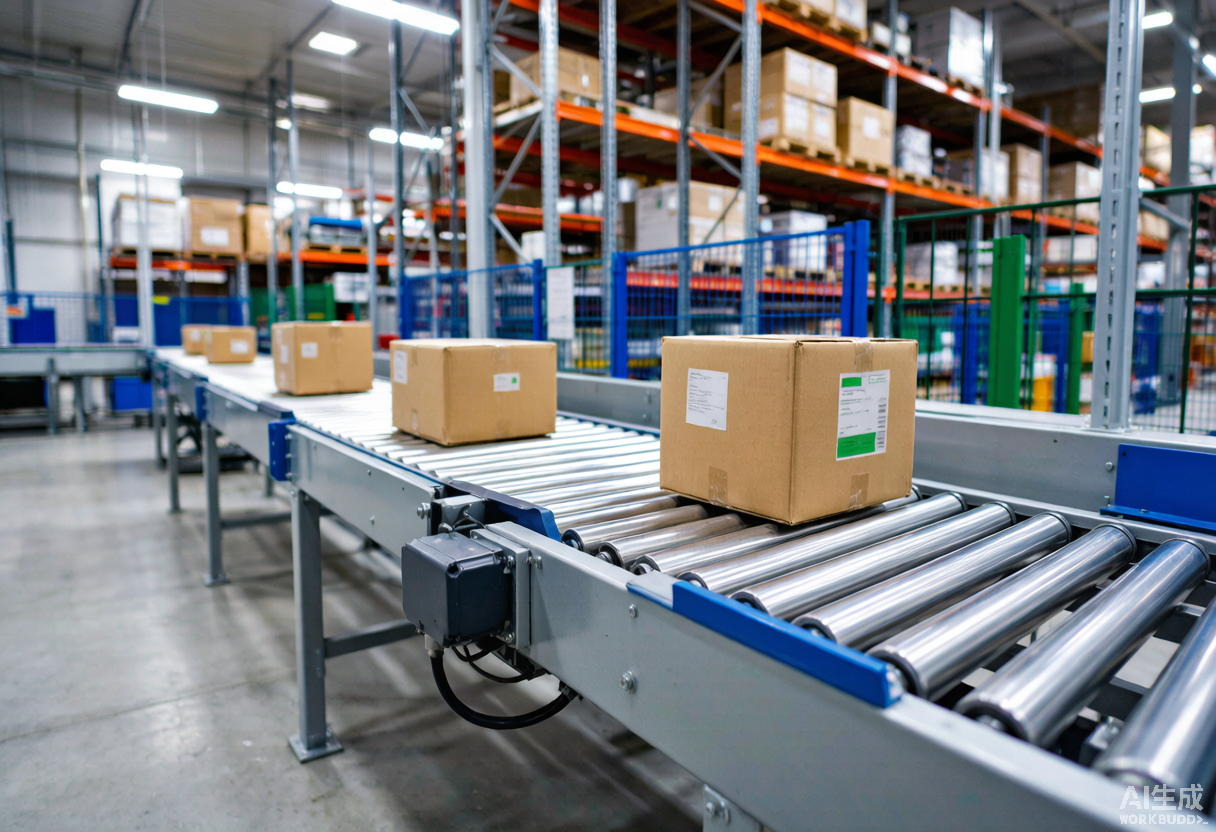
Roller conveyors come in two fundamental flavors: gravity and powered. Both move goods on rollers, but they operate on completely different principles — and the choice between them shapes your conveyor system’s cost, capability, and control.
Guosheng manufactures both types, including the Powered Roller Conveyor and gravity models like the telescopic roller conveyor and spiral gravity roller conveyor. Here is the breakdown.
What Is a Gravity Roller Conveyor?
A gravity roller conveyor relies on a slight slope to move goods. No motors, no power — items roll downhill under their own weight. It is the simplest, most economical conveyor there is.
- Cost: lowest initial and operating cost
- Energy: zero consumption
- Maintenance: minimal — few moving parts
- Limitation: only downhill or manual-push flow, speed not controlled
What Is a Powered Roller Conveyor?
A powered roller conveyor uses motor-driven rollers (motorized, belt-driven, or chain-driven) to move goods automatically — level, uphill, or downhill, at a controlled speed.
- Capacity: 50–2,000 kg/m depending on configuration
- Speed: 10–60 m/min, adjustable
- Control: PLC-compatible, integrates with sorters and WMS/WCS
- Automation: enables accumulation, indexing, and merging
Gravity vs Powered: Comparison Table
| Criterion | Gravity Roller | Powered Roller |
|---|---|---|
| Energy use | None | Electric motors |
| Initial cost | Low | Higher |
| Capacity | Light-medium | Up to 2,000 kg/m |
| Speed control | None | Adjustable 10–60 m/min |
| Direction | Downhill only | Any direction |
| Automation ready | No | Yes (PLC, WMS/WCS) |
| Best for | Simple, low-cost transfer | Automated, high-volume flow |
How to Choose
- Moving light goods downhill with no control need? Gravity is the economical choice.
- Need level or uphill transport, speed control, or integration with sorters? Choose powered.
- Handling heavy loads (above gravity capacity)? Powered rollers handle up to 2,000 kg/m.
- Building a fully automated line? Powered rollers are the standard building block.
Conclusion
Gravity and powered roller conveyors are complementary, not competing. Use gravity for simple, low-cost flow where gravity does the work. Invest in powered rollers where you need control, automation, and capacity. Guosheng supplies both — and can design a hybrid system that optimizes cost and capability.
Need help designing your conveyor line? Talk to Guosheng’s engineers.
Frequently Asked Questions
Q: What is the difference between a gravity and powered roller conveyor?
A: A gravity roller conveyor moves goods downhill using slope and gravity with no power. A powered roller conveyor uses motor-driven rollers for controlled movement in any direction, with adjustable speed and higher load capacity.
Q: When should I use a gravity roller conveyor?
A: Use gravity roller conveyors for lightweight goods, downhill flow, and budget-conscious applications where speed control and automation are not required — such as unloading lines and simple transfers.
Q: How much does a powered roller conveyor cost?
A: Powered roller conveyors cost more than gravity units due to motors and controls, but they enable automation, speed control, and much higher capacity (up to 2,000 kg/m). The investment pays back through reduced labor and increased throughput.