
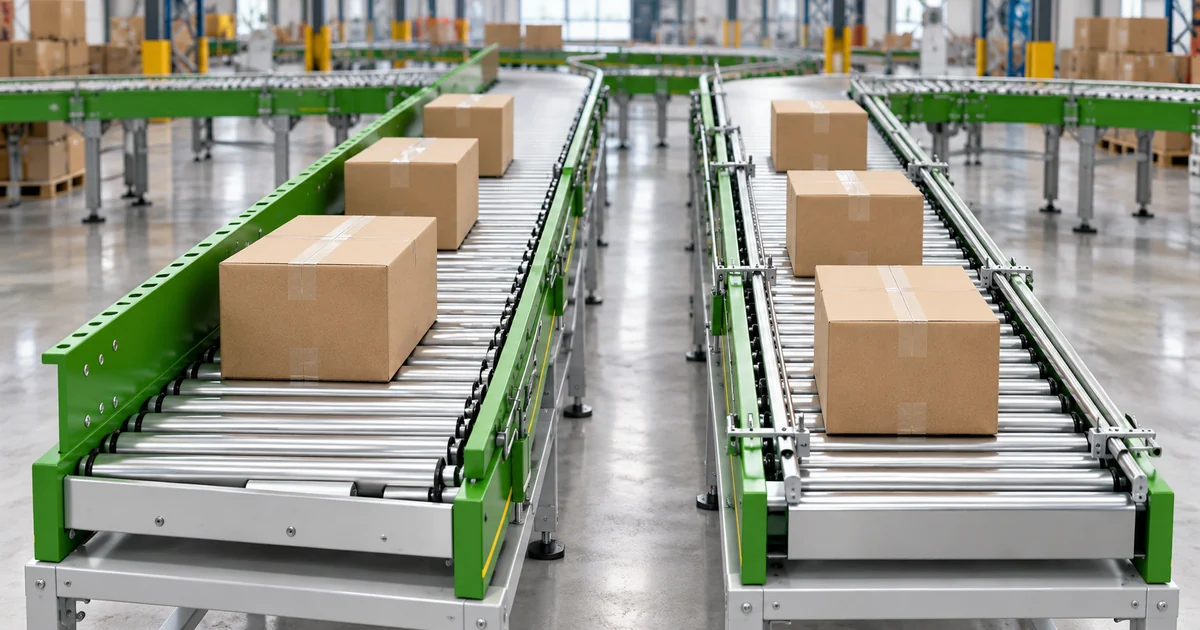
Choosing a side alignment conveyor vs centering conveyor is a positioning decision, not just a roller specification. Both systems move cartons and parcels while correcting their lateral position, but they create different reference points for the next process. Side alignment guides items toward one edge. Centering places items near the conveyor centerline.
The better choice depends on what happens next: scanning, labeling, measuring, sorting, packaging, merging, or transfer to another conveyor. This guide explains the difference and lists the project data needed before an equipment layout is approved.
Side Alignment Conveyor vs Centering Conveyor: The Core Difference
A side alignment roller conveyor uses arranged rollers and guide mechanisms to move products toward a selected side during transportation. The result is an edge-based reference. This can be useful when downstream equipment expects one side of every carton to arrive in a repeatable position.
A centering roller conveyor moves cartons, parcels, packages, or totes toward the middle of the conveyor. The result is a centerline reference. This can help when the next machine needs balanced clearance on both sides or when the load should approach a central processing zone.
Both GSSort product pages list powered rollers, adjustable speed, customized width and length, steel or PVC roller options, and carbon-steel frames. Those shared specifications do not make the two functions interchangeable. The required final position should determine the alignment method.
Quick Comparison
| Selection factor | Side alignment roller conveyor | Centering roller conveyor |
|---|---|---|
| Positioning reference | One selected conveyor edge | Conveyor centerline |
| Typical design objective | Create a repeatable side position | Create balanced left-right position |
| Useful before | Side-referenced scanning, labeling, transfer, or guide equipment | Centered scanning, measuring, packaging, sorting, or transfer equipment |
| Important risk to test | Excess side pressure, unstable loads, and guide clearance | Inconsistent center position across mixed parcel widths |
| Project variables | Parcel size, weight, base condition, speed, entry position, required exit tolerance, and downstream interface | |
This comparison is a planning framework. The actual conveyor geometry and operating limits must be confirmed from the parcel profile and line layout.
When Side Alignment Is the Better Fit
Choose side alignment when the next process needs a consistent edge reference. For example, a side-mounted device may need cartons to approach within a defined distance, or a transfer point may work more reliably when every load occupies the same side of the conveyor.
Side alignment can also simplify a line in which loads arrive at different lateral positions but must leave against one guide. The selected side should match the downstream equipment, operator access, and product flow. Changing sides later can require extra conveyor length or another positioning section.
Before choosing this method, inspect irregular loads carefully. Soft parcels, damaged cartons, protruding straps, tapered boxes, and unstable products may react differently from a rigid carton. The design must avoid trapping, rotating, or applying unsuitable side force to those items.
When Centering Is the Better Fit
Choose centering when the next process uses the conveyor centerline as its reference. A central position can be useful before equipment that needs similar clearance on both sides, such as selected scanning, measuring, wrapping, sorting, or transfer arrangements.
Centering may also help standardize the approach to a downstream conveyor that is narrower than the upstream section. However, the centered parcel still needs enough side clearance for the entire accepted size range. A large carton that fits on paper may not leave adequate tolerance for movement, skew, or guide components.
Mixed widths need special attention. The equipment should place both narrow and wide items within the required exit tolerance, not merely make an average carton look centered during a demonstration.
Start With the Downstream Interface
The downstream machine defines the useful alignment result. Ask the equipment supplier or integrator for the required entry position and tolerance. A statement such as “items must be aligned” is not precise enough. The project brief should state whether the reference is the left edge, right edge, or centerline, plus the acceptable deviation.
Then document the distance between the alignment section and the next process. A parcel can drift, rotate, or be disturbed after positioning, especially across transfers or changes in conveyor type. The complete path should be reviewed, not only the alignment module.
For related equipment options, see the roller conveyor category and the powered roller conveyor product page. GSSort’s roller conveyor systems guide provides a broader overview of warehouse conveyor selection.
Seven Inputs to Include in the Project Brief
- Required exit position: Define the target edge or centerline and the acceptable lateral tolerance.
- Parcel dimensions: Provide minimum, typical, and maximum length, width, and height.
- Weight range: Include normal and maximum weight, plus unusually dense items.
- Packaging condition: Identify rigid cartons, totes, soft bags, damaged boxes, straps, and uneven bases.
- Entry condition: Record how far items may be off-center, skewed, or touching a side when they enter.
- Flow requirement: Separate average and peak demand, and describe parcel spacing or accumulation.
- Downstream equipment: Show scanners, labelers, sorters, pack stations, transfers, and guide rails on the layout.
These inputs allow the supplier to review conveyor width, roller arrangement, guide geometry, speed, controls, and required test samples. They also prevent a generic alignment claim from replacing a measurable acceptance target.
Integration With Scanning, Labeling, and Sorting
Positioning and identification should be designed together. If a barcode reader or camera has a fixed field of view, the aligned parcel must present the expected label area. If a label applicator uses a side reference, the carton edge and label surface must remain stable through the application zone.
For a sorting line, confirm whether alignment is needed before identification, before the divert mechanism, or both. The control system should also know how to respond when a parcel cannot be positioned within tolerance. Possible project-specific responses include rejection, manual inspection, line stop, or routing to an exception lane.
Do not assume that faster conveyor speed automatically produces higher usable throughput. The line needs enough distance and time to reposition the accepted parcel range while maintaining safe gaps and stable tracking.
Testing and Acceptance Criteria
Use representative parcels during factory and site acceptance testing. Include the smallest, largest, lightest, heaviest, most flexible, and most damaged acceptable items. Run them from different entry positions and orientations rather than feeding every sample neatly.
- Measure exit position against the agreed edge or centerline tolerance.
- Test normal and peak operating speeds.
- Check skew, rotation, stalls, and contact with guides.
- Verify transfers into the next conveyor or machine.
- Test start, stop, restart, accumulation, and blocked downstream conditions.
- Record products that require a different route or manual handling.
A measurable test plan is more useful than a visual judgment that parcels appear aligned.
Safety and Maintenance Access
Alignment mechanisms add contact points, guides, drives, sensors, and adjustment areas. The layout should provide safe access for inspection, cleaning, jam removal, and replacement of wear components. Guarding and emergency-stop placement must be evaluated for the completed line.
Conveyor requirements depend on the installation and jurisdiction. ASME B20.1 addresses safety considerations for conveyors and related equipment. The applicable standards and local regulations should be confirmed for the final system.
Frequently Asked Questions
What is the main difference between side alignment and centering?
Side alignment moves a parcel toward one selected conveyor edge. Centering moves it toward the conveyor centerline. The correct method is the one that creates the reference position required by the next process.
Can one conveyor handle cartons, parcels, and totes?
The GSSort product pages list cartons, parcels, packages, and totes as applicable product types. Final suitability still depends on dimensions, weight, base condition, rigidity, and representative testing.
Can conveyor width, length, and speed be customized?
Yes. Both product pages list customized conveyor width and length with adjustable speed. The engineered configuration should be based on the parcel range, positioning tolerance, layout, and throughput requirement.
Where should an alignment conveyor be installed?
Install it far enough upstream to achieve the required position, but close enough to the next process that parcels do not drift or rotate before arrival. The exact location should be validated on the complete line layout.
Choose the Reference Position First
The side alignment conveyor vs centering conveyor decision becomes simpler when the downstream reference and tolerance are measurable. Start with the next machine, document the real parcel range, and test difficult items before final approval. Contact GSSort with your layout, parcel data, and target exit position to discuss a project-specific roller conveyor configuration.