
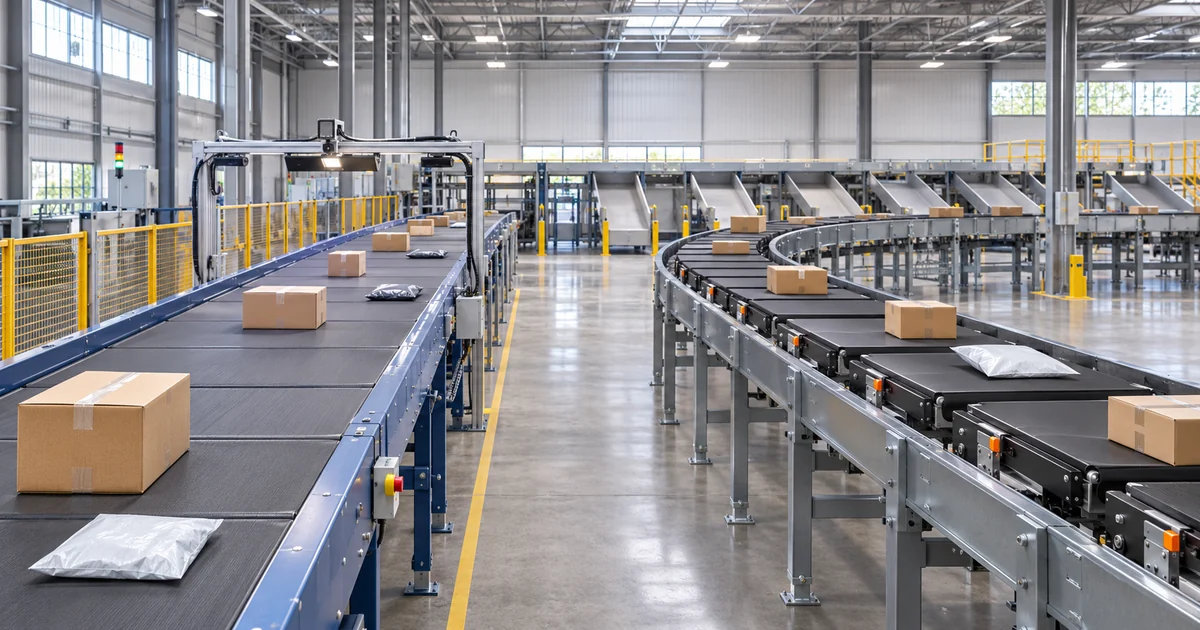
Choosing a modular belt sorter vs cross-belt sorter is not simply a question of which machine is faster. The useful answer depends on parcel dimensions, packaging condition, destination count, available floor space, induction quality, control-system requirements, and the way exceptions will be handled.
Both technologies can support automated parcel routing, but they organize the sorting process differently. A modular belt solution can be configured around multiple lanes and gravity-fed or powered discharge layouts. A cross-belt solution uses individual carrier belts on a main conveyor path to discharge items toward assigned destinations. This guide turns those differences into a practical project brief.
Modular Belt Sorter vs Cross-Belt Sorter: The Core Difference
The GSSort modular belt sorter is presented as a scalable parcel sorting system for cartons and lightweight packages. Its published product information highlights a multi-lane modular belt configuration, gravity-fed or powered layouts, custom line design, and integration with automated warehouse systems.
The GSSort cross-belt sorter uses individual cross belts on a main conveyor chain. Each carrier can discharge a parcel toward a selected destination. The product page lists handling for small, medium, and lightweight parcels, integration with WMS, WCS, DWS, barcode, or RFID systems, and a stated capacity of up to 10,000 parcels per hour. That figure is a product-page maximum, not a guaranteed project result.
The practical difference is therefore not “basic” versus “advanced.” It is a choice between two line architectures. The right architecture is the one that can repeatedly accept the real parcel mix, identify each item, create the required gaps, reach every destination, and recover from faults without unacceptable disruption.
Quick Comparison
| Selection factor | Modular belt sorter | Cross-belt sorter |
|---|---|---|
| Published system concept | Multi-lane modular belt configuration | Individual cross-belt carriers on a main conveyor path |
| Published discharge options | Gravity-fed or powered sorting layouts | Carrier belts discharge parcels to assigned destinations |
| Published parcel description | Parcels, cartons, and lightweight packages | Small, medium, and lightweight parcels |
| Controls emphasis | Integration with automated warehouse systems | WMS, WCS, DWS, barcode, or RFID integration |
| Important project question | Can the lane and discharge layout fit the required destinations and parcel range? | Can induction, identification, carrier loading, and discharge operate as one stable process? |
This table summarizes published product concepts. Final geometry, speed, capacity, and accepted parcel limits must be confirmed through engineering review and representative testing.
Start With the Parcel Profile
A sorter should be selected against the full accepted parcel range, not an average carton. Record minimum, typical, and maximum length, width, height, and weight. Add packaging condition: rigid cartons, soft poly mailers, padded envelopes, strapped packages, unstable bases, damaged boxes, and irregular items can behave differently during transport and discharge.
The base of the item matters because it is the contact surface. A flat, rigid carton may track predictably, while a soft bag can sag, wrinkle, rotate, or bridge a gap. If those items are part of normal production, include them in supplier testing rather than treating them as rare exceptions.
Also define which items the automated line will reject. A clear exception policy can be safer and more reliable than forcing every possible package through one sorter. Oversize, underweight, leaking, round, unstable, or unreadable items may need a manual or alternate route.
Destination Count and Discharge Layout
Destination count is only the first layout input. Each destination also needs a physical discharge point, takeaway path, chute, accumulation area, or operator interface. A line with many theoretical destinations can still fail if downstream containers fill too quickly or if operators cannot clear them safely.
For a modular belt sorter, review how the multi-lane arrangement maps to the required discharge layout. Confirm whether each lane is gravity-fed or powered, how products transition into the destination, and how the line will be expanded if route count increases.
For a cross-belt sorter, review the complete carrier path, induction positions, discharge points, recirculation logic, and space required around the loop. The sorter itself is only one part of the footprint. Infeed, identification, chutes, takeaway conveyors, access aisles, and maintenance zones all belong on the drawing.
Throughput Is a System Result
GSSort’s cross-belt product page lists up to 10,000 parcels per hour. A real line may operate below a published maximum because usable throughput depends on parcel length, required gap, induction accuracy, unreadable labels, destination availability, recirculation, control response, and downstream congestion.
The modular belt product page describes high-throughput handling for medium and large parcel volumes without publishing a fixed hourly number. That is not a basis for guessing one. Request a capacity calculation using the accepted parcel distribution and the actual layout.
Separate average demand, normal peak demand, and short surge demand. Then define the test duration. A short demonstration at high speed does not prove that the complete line can sustain the same result while destinations fill, exceptions occur, and operators perform normal work.
Induction, Identification, and Controls
Accurate sorting begins upstream. Items must arrive with suitable spacing and orientation, and the system must associate the correct identity with the correct physical parcel. Barcode readers, cameras, DWS equipment, sensors, PLCs, WCS, and WMS interfaces should be reviewed as one data path.
The cross-belt product page specifically lists WMS, WCS, DWS, barcode, and RFID integration. For either sorter type, the project brief should define message ownership, route-decision timing, lost-read handling, duplicate-read handling, destination-full logic, and the response to a communication failure.
MHI’s discussion of bulk-to-singulated parcel flow reinforces the need to evaluate the complete conveyance and sortation process rather than an isolated machine. In practical terms, poor singulation or identification can limit a capable sorter.
Maintenance and Fault Recovery
Maintenance planning should begin before the layout is approved. Ask how technicians reach belts, carriers, sensors, drives, and discharge areas. Identify wear components, recommended spares, inspection intervals, cleaning access, and the time needed to isolate a section safely.
The two architectures can create different service tasks. A modular multi-lane arrangement requires access to its belt sections and discharge components. A cross-belt system adds multiple carriers and a circulating path that must be inspected and tracked. The project team should compare maintainability using the proposed configuration, not a generic technology label.
Fault recovery is equally important. Define what happens after an emergency stop, power interruption, unreadable parcel, blocked destination, or failed sensor. The control sequence should prevent parcel identity from becoming separated from physical position during restart.
Nine Inputs for a Useful Supplier Review
- Parcel range: Minimum, typical, and maximum dimensions and weight.
- Packaging mix: Cartons, bags, envelopes, straps, damaged items, and irregular bases.
- Flow demand: Average, peak, surge duration, and expected growth.
- Destination plan: Current and future route count, discharge type, and downstream capacity.
- Identification method: Barcode, RFID, camera, DWS, and unreadable-item process.
- Facility drawing: Columns, doors, clear height, floor loading, utilities, and access aisles.
- System interfaces: PLC, WCS, WMS, network, data ownership, and route-decision timing.
- Exception policy: Oversize, unstable, damaged, unknown, or destination-full parcels.
- Acceptance criteria: Measurable capacity, accuracy, availability, parcel condition, and test duration.
For a wider technology overview, review the automated sorting system category, the automated sorting systems guide, and GSSort’s existing cross-belt sorter planning guide.
Testing and Acceptance
Factory acceptance testing should use a representative sample set. Include the smallest, largest, lightest, heaviest, softest, and most difficult acceptable packages. Feed them at realistic orientations and spacing. Do not limit testing to clean, rigid cartons placed neatly by hand.
- Measure sustained throughput over an agreed test period.
- Record correct destinations, mis-sorts, no-reads, recirculations, and manual interventions.
- Inspect packages for jams, drops, rotation, scuffing, or unsuitable impact.
- Test full destinations, blocked takeaways, and exception routing.
- Test stop, emergency stop, restart, and power-recovery sequences.
- Confirm data exchange with the actual WCS or WMS interface.
Acceptance criteria should state the parcel mix and operating conditions behind each target. A capacity number without those conditions is incomplete.
Safety and Access
Guarding, emergency stops, safe isolation, controls, platforms, and maintenance access must be reviewed for the complete installed line. Chutes and takeaway conveyors can create additional pinch, fall, and access hazards beyond the sorter itself.
ASME lists B20 safety standards for conveyors and related equipment among its safety codes and standards. Applicable editions, local regulations, and site requirements should be confirmed by the project team for the final installation.
Frequently Asked Questions
Is a cross-belt sorter always faster than a modular belt sorter?
No universal comparison can be made without a defined parcel mix and layout. The GSSort cross-belt page lists up to 10,000 parcels per hour, while the modular belt page does not publish a fixed number. Ask for calculations and sustained testing under the same project conditions.
Which sorter is better for soft bags and poly mailers?
Suitability depends on bag size, fill, stiffness, seams, protrusions, and how the item contacts each transfer. Representative soft packages should be tested on the proposed configuration. Do not approve either technology from carton-only trials.
Can both systems connect to warehouse software?
The modular belt page lists integration with automated warehouse systems. The cross-belt page specifically lists WMS, WCS, DWS, barcode, and RFID integration. The final interface scope, message ownership, and failure behavior still need project-level definition.
What data should be sent before requesting a layout?
Send the facility drawing, parcel dimensions and weights, packaging mix, average and peak flow, destination count, discharge requirements, identification method, software interfaces, exception policy, and measurable acceptance criteria.
Choose the Architecture From the Operating Data
The modular belt sorter vs cross-belt sorter decision should follow the operating data, not precede it. Build the parcel profile, map every destination, define controls and exceptions, reserve maintenance access, and agree on a realistic acceptance test. Contact GSSort with those inputs to discuss a project-specific automated sorting layout.