
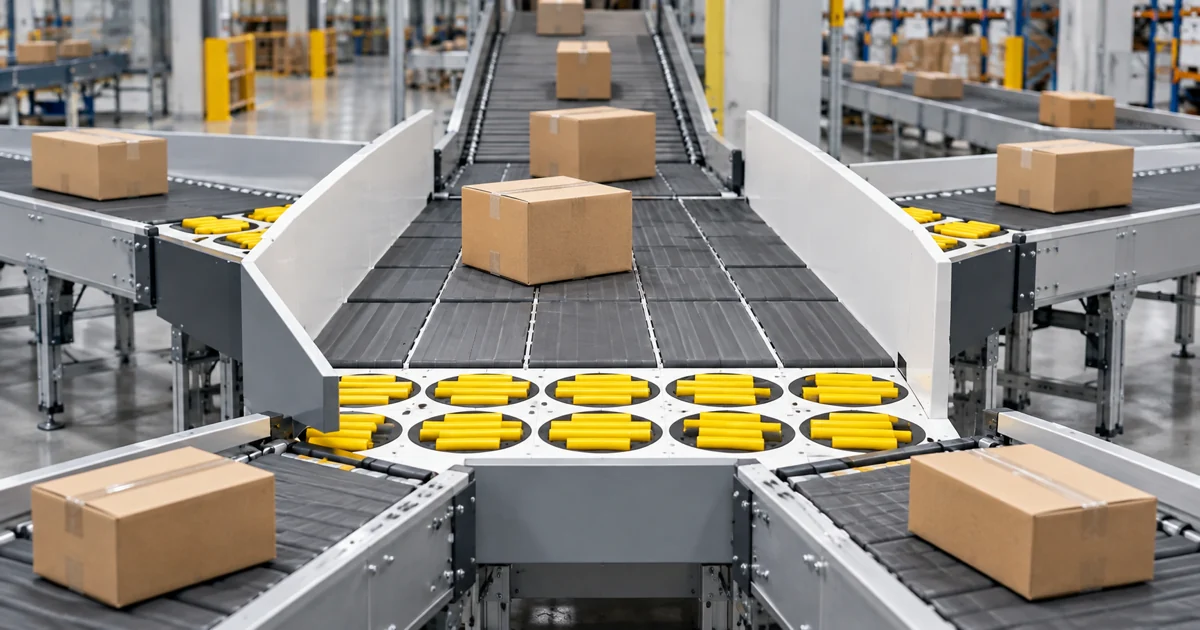
A turntable wheel sorter is designed for parcel flows that need several routing directions within a limited area. Instead of extending a long line of separate divert points, the equipment combines a rotating turntable concept with wheel-driven conveying to direct cartons and parcels toward connected lanes. The compact layout can be useful in fulfillment centers, parcel hubs, 3PL warehouses, and distribution operations where floor space and route geometry both matter.
This guide explains how the equipment fits into a conveyor system, which project inputs affect selection, and what to verify before requesting a layout or quotation.
How a Turntable Wheel Sorter Works
The sorting zone uses controlled wheel modules to change the travel direction of an item as it passes through the turntable area. The surrounding conveyor lanes can be arranged to receive parcels from different directions, allowing the sorter to serve a compact junction rather than a single straight-line divert.
GSSort’s turntable wheel sorter is presented as a multi-direction parcel-routing solution for complex warehouse layouts. The product page lists PLC-based control and compatibility with WMS, WCS, and DWS integration. These interfaces are important because the mechanical sorter still needs an accurate destination decision, parcel tracking, and coordinated commands from the wider control system.
When a Turntable Wheel Sorter Makes Sense
This sorter type is worth evaluating when the project has several nearby routes but limited room for multiple conveyor turns. It can also be relevant when parcels must move between different process areas, such as induction, inspection, packing, carrier lanes, or exception handling, without building a long linear sortation section.
A compact machine is not automatically the best choice for every compact warehouse. The final decision depends on parcel stability, lane geometry, target flow, upstream spacing, downstream capacity, and the recovery plan for blocked exits. A layout review should therefore start with the operating process rather than the machine footprint alone.
Reference Specifications to Review
The current GSSort product page lists the following reference values. They describe available configurations, not a guaranteed result for every application. Actual performance depends on the parcel mix, controls, induction quality, route logic, and final engineered layout.
| Item | Published reference | What to confirm for your project |
|---|---|---|
| Conveying speed | 45-120 m/min | Required spacing, tracking method, and parcel stability at the intended speed |
| Sorting efficiency | 4,000-6,000 items/hour | Real parcel distribution, route mix, blocked-lane logic, and operating availability |
| Swing angle | +/-45 degrees, with customizable layouts listed | Exact infeed and discharge angles shown on a scaled plan |
| Sorting weight | Up to 60 kg per item | Normal and maximum weights, center of gravity, base condition, and impact at discharge |
| Equipment width | 220 to 1,260 mm listed, plus non-standard customization | Parcel footprint, side clearance, guarding, and service access |
| Drive method | Servo drive | Control architecture, power supply, maintenance access, and spare-parts plan |
Use these figures to begin a technical discussion, not to size a system without testing. Representative parcels and a clear operating scenario are necessary before performance can be confirmed.
Six Inputs Needed Before Layout Design
- Parcel dimensions and weight: Provide the minimum, typical, and maximum values rather than only an average.
- Packaging condition: Note soft bags, uneven bottoms, straps, damaged cartons, protrusions, and other items that may not transfer like a rigid box.
- Route map: Mark the infeed, every discharge direction, downstream equipment, operator areas, columns, walls, and service aisles.
- Flow requirement: Separate average demand, peak demand, and the expected destination distribution. A short peak can be more important than a daily total.
- Decision source: Identify whether routing comes from a barcode reader, dimension-weigh-scan system, WCS, WMS, PLC table, or manual input.
- Exception strategy: Define what happens when a label cannot be read, an exit is full, tracking is lost, or a parcel is outside the accepted profile.
These inputs help the equipment supplier determine the required machine width, interfaces, controls, guarding, and support conveyors. They also expose process gaps before fabrication begins.
Plan the Infeed and Discharge Lanes Together
The turntable wheel sorter is only one part of the material flow. Upstream equipment must deliver parcels with sufficient spacing and stable orientation for tracking. If two items enter the sorting zone as one object, or if a parcel changes position after identification, the control decision may no longer match the physical item.
Downstream lanes need enough capacity to accept the assigned flow. A blocked conveyor or full chute can create a backup at the sorter even when the divert mechanism is working correctly. During design, document lane-full signals, stop zones, recirculation options, rejection routes, and restart behavior.
For projects that need a broader technology review, compare the full automated sorting system range. The existing wheel sorter vs narrow belt sorter guide also explains how destination layout and conveyor flow affect the choice between two common approaches.
Controls and Data Integration
A routing command normally depends on several linked events: item detection, identification, destination assignment, position tracking, divert actuation, and confirmation. The controls design should define who owns each decision and how the system responds when data is missing or delayed.
If the project connects to a WMS or WCS, agree on the interface message, item identifier, destination table, status feedback, and fault codes before commissioning. For DWS integration, confirm where dimension, weight, and barcode data enter the routing logic. A clear interface specification reduces the risk of discovering incompatible assumptions during site testing.
Safety and Maintenance Access
Compact layouts can create tight service areas, so maintenance clearance should be shown on the drawing rather than left for installation. Review access to drives, sensors, wheel modules, electrical panels, emergency stops, guarding, and cleaning points. Operators also need a safe procedure for removing a stalled or rejected parcel.
Conveyor safety requirements vary by installation and jurisdiction. ASME B20.1 addresses safety considerations for conveyors and related equipment. The project team should identify the standards and local requirements that apply to the completed system instead of treating a component specification as a complete safety assessment.
Commissioning Tests to Include
Commissioning should use representative items from the actual parcel mix. Test each route at normal and peak operating conditions, then test the failure cases that are likely to interrupt production.
- Minimum, typical, and maximum parcel sizes and weights
- Every configured infeed and discharge direction
- Unreadable labels and parcels without a destination
- Blocked or full downstream lanes
- Emergency stop, restart, and tracking recovery
- Communication loss between PLC, WCS, WMS, or DWS
- Access for cleaning, inspection, and routine maintenance
Record the acceptance method before testing begins. Measured results, fault logs, and agreed pass criteria provide a more reliable handover than a short demonstration with ideal cartons.
Frequently Asked Questions
What is a turntable wheel sorter?
It is a conveyor sorting module that combines a turntable-style routing zone with driven wheel modules. The equipment redirects parcels toward connected conveyor lanes, making multi-direction routing possible within a concentrated area.
Is a turntable wheel sorter suitable for small warehouses?
It can suit a space-constrained warehouse when several routes must meet in one area, but suitability depends on parcel dimensions, lane geometry, throughput, controls, guarding, and maintenance clearance. A scaled layout is needed to confirm the benefit.
What parcel data should be sent with a quotation request?
Send minimum, typical, and maximum dimensions and weights, packaging types, photos or samples of difficult items, average and peak flow, destination count, and a layout showing all connected equipment.
Can the sorter connect to WMS or WCS software?
The GSSort product page lists WMS, WCS, and DWS compatibility. The exact interface, message format, routing responsibility, and exception logic still need to be defined for each project.
Build the Layout Around the Real Parcel Flow
A turntable wheel sorter can simplify a multi-direction junction, but the strongest design starts with verified parcel data and a complete route map. Treat the sorter, infeed, discharge lanes, scanners, controls, guarding, and exception flow as one system. Contact GSSort with your parcel profile and layout to discuss a project-specific configuration.