
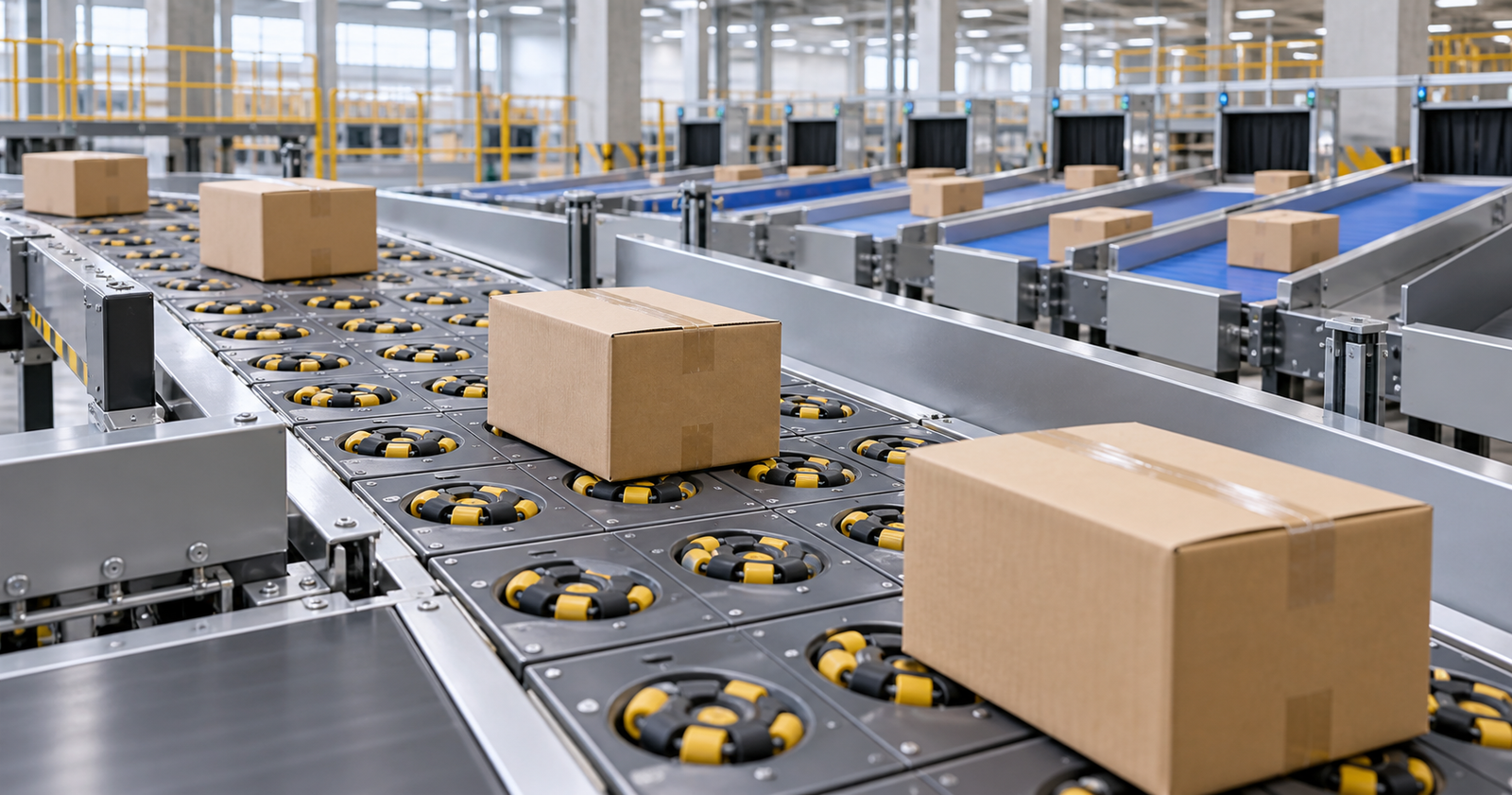
Choosing between a wheel sorter and a narrow belt sorter is not simply a choice between two divert mechanisms. The right fit depends on the parcel mix, the number and position of destinations, the available footprint, and how the sorter connects with the surrounding conveyor flow. This guide compares the two approaches so warehouse teams can prepare a clearer brief before a layout review.
Wheel Sorter vs Narrow Belt Sorter: The Core Difference
A wheel sorter uses individually controlled wheel or roller modules to redirect a carton, tote, or parcel toward a selected route. Depending on the module arrangement, the transfer can support angled or multi-direction movement within a compact sortation zone. A wheel sorter is often considered when a line needs flexible routing choices without creating a long sequence of fixed diverts.
A narrow belt sorter moves loads along parallel belts and diverts them to assigned exits by changing the path at the appropriate point. It is a familiar option for parcel, postal, and e-commerce flows where the parcel profile and route logic are well defined. Both technologies can be part of an automated sorting system, but their selection criteria are not identical.
Start With the Parcel Flow, Not the Equipment Name
The best first step is to describe what moves through the system. Record the smallest and largest parcel footprint, typical weight range, surface condition, rigidity, label orientation, and whether items arrive with gaps or in accumulation. A sorter must guide the load reliably through the whole transfer, so the condition of the load matters as much as the desired routing pattern.
Also map the flow before and after the sorter. Is the infeed a belt conveyor, roller conveyor, induction line, or manual loading point? Do parcels leave to chutes, packing stations, downstream conveyors, or multiple carrier lanes? A clear flow map helps determine whether the sorter needs a straight run, multiple exit angles, a compact transfer zone, or additional singulation and accumulation upstream.
When a Wheel Sorter Can Be the Better Fit
A wheel sorter can be a strong candidate when the layout needs flexible directional changes in a concentrated area. The wheel modules can support routing choices that would otherwise require several separate conveyor turns or fixed divert points. This makes the technology worth evaluating for multi-destination parcel flows, compact sortation cells, and layouts where the relationship between infeed and exits is not purely linear.
It is especially useful to discuss a wheel sorter with an integrator when the layout has several nearby exits, when parcels must be steered toward different directions, or when the available floor area limits the length of the sorting section. The final equipment choice should still be based on a tested parcel sample and a complete controls concept, rather than on layout appearance alone.
When a Narrow Belt Sorter Can Be the Better Fit
A narrow belt sorter is often a practical option for established parcel flows that need repeatable routing from a main line to defined destinations. Its structure suits operations where the induction process, parcel spacing, exit positions, and downstream handling are planned as a coordinated system. It can be appropriate for postal, parcel, and e-commerce operations that need to connect multiple destinations along a sortation line.
Before selecting a narrow belt sorter, confirm how parcels will be inducted, how much spacing is needed for accurate tracking, and what happens at each destination when the downstream lane is occupied. These operational details affect the controls design and the amount of accumulation required. The sorter should be selected as part of the full material-flow solution, not as an isolated machine.
Five Selection Questions to Put in Your Project Brief
- What is the actual parcel profile? Include dimensions, weight range, packaging condition, and any unstable or irregular items.
- How many destinations are required? Mark every exit, its direction, and what equipment receives the parcel afterward.
- What happens during a blocked destination? Define whether parcels recirculate, accumulate, stop upstream, or need an alternative route.
- What footprint is available? Measure the usable length, width, ceiling constraints, operator access, and service clearance.
- What operational information drives sorting? Identify the barcode, WMS, PLC, or manual decision source that assigns a parcel to an exit.
These inputs make a comparison between a wheel sorter and a narrow belt sorter more useful. They also help a supplier identify whether the project needs supporting equipment such as infeed conveyors, transfers, accumulation, scanners, chutes, or controls integration.
Plan the Infeed and Destinations as One System
Sorter performance depends on the conditions created before the parcel reaches the divert point. Induction quality, gap control, tracking, and parcel orientation all influence how consistently a system can route each item. On the discharge side, chutes and conveyors must accept the diverted parcel without creating a recurring backup.
For a broader view of the available technologies, review Guosheng’s automated sorting system category. For heavy-duty or pivot-arm handling scenarios, the swing arm sorter provides a different kind of routing solution. Comparing these alternatives with the real parcel flow helps avoid forcing one machine type into every application.
Safety, Access, and Commissioning Matter
Layout planning should include guarding, emergency-stop access, maintenance clearance, controls validation, and operator procedures from the start. Conveyor and related equipment safety requirements are addressed by standards such as ASME B20.1; the applicable requirements should be reviewed for the installation location and final equipment configuration.
During commissioning, use representative parcels and real routing scenarios. Verify normal operation, blocked exits, recovery behavior, fault handling, and operator access before the system enters routine production. A documented acceptance plan reduces uncertainty and makes it easier to refine the system around actual operating conditions.
Frequently Asked Questions
What is the main difference between a wheel sorter and a narrow belt sorter?
A wheel sorter directs parcels through controlled wheel or roller modules and can be useful for flexible routing within a compact zone. A narrow belt sorter uses parallel belts and planned divert points along a sortation line. The right choice depends on parcel characteristics, destination layout, controls, and footprint.
Can a wheel sorter handle every parcel type?
No. Each project needs a review of parcel dimensions, weight, base condition, stability, and packaging. Representative sample testing and a complete flow assessment are the soundest way to confirm equipment suitability.
Does a narrow belt sorter need upstream parcel spacing?
Yes. A controlled induction and clear parcel tracking are central to routing parcels to the correct destination. The exact spacing and controls approach depend on the system design and the parcel flow.
What information should I send for a sorter quotation?
Provide parcel data, routing destinations, target flow pattern, layout dimensions, upstream and downstream equipment, operating hours, and the control or data source used for sorting decisions.
Choose the Sorter Around Your Real Flow
A wheel sorter versus narrow belt sorter comparison becomes straightforward when the parcel data, destinations, and operating constraints are visible. The aim is not to select the most complex machine; it is to build a routing zone that supports the actual process with maintainable equipment and clear controls. Contact Guosheng to discuss your parcel profile and layout requirements with an equipment team.