
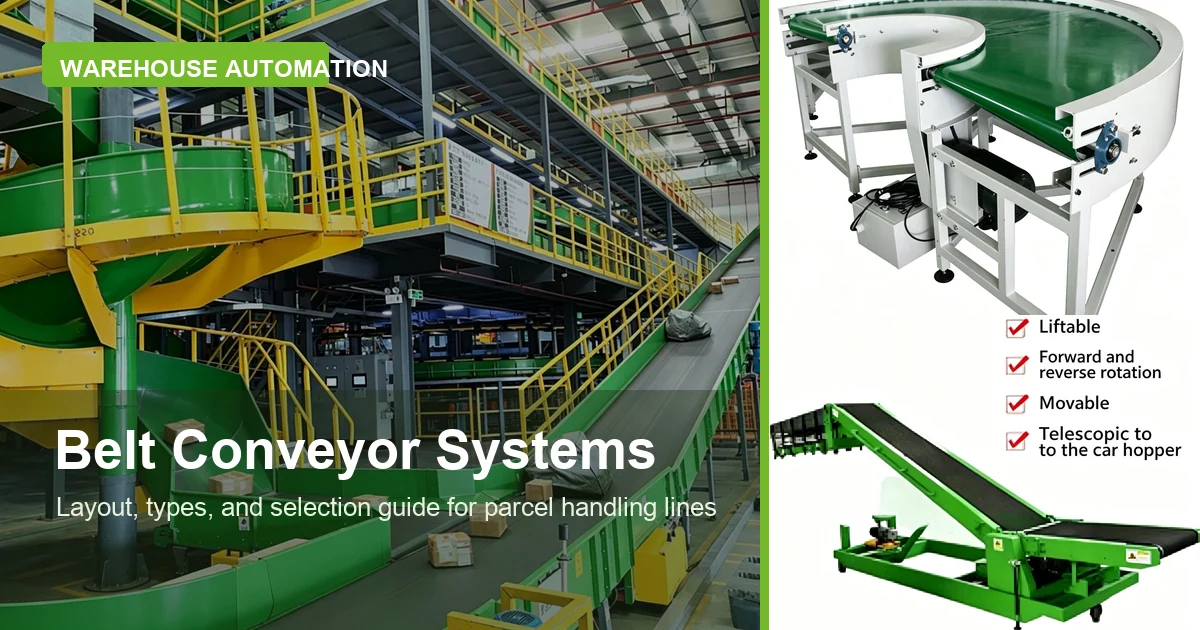
Belt conveyor systems are often the quiet backbone of warehouse automation. Sorters, chutes, vertical lifts, and packing stations can only perform well when the material flow between them is stable, predictable, and easy to control. For parcel hubs, e-commerce fulfillment centers, manufacturing warehouses, and 3PL distribution sites, the right belt conveyor layout can reduce manual handling, prevent bottlenecks, and keep goods moving through each operating zone.
This guide explains how to plan belt conveyor systems for warehouse automation, how the main conveyor types differ, and what information buyers should prepare before requesting a project quotation. It is written for logistics managers, warehouse engineers, and procurement teams comparing conveyor options for new lines, line upgrades, or automated sorting projects.
Why belt conveyor systems matter in warehouse automation
A conveyor line is not only a transport path. It controls the rhythm of receiving, scanning, weighing, merging, sorting, loading, and dispatch. If the conveyor is too narrow, too slow, poorly positioned, or difficult to access for maintenance, the entire automation project can lose capacity even when the main machines are technically strong.
In modern facilities, belt conveyors are commonly used to move cartons, parcels, mailers, totes, bags, and lightweight goods between work areas. They are especially useful when items need smooth, continuous movement over longer distances or through controlled transitions. Compared with relying on manual carrying, a well-designed conveyor system helps operators reduce repeated lifting and improve process consistency. The OSHA warehousing overview also highlights material handling and ergonomics as important warehouse safety topics, which makes conveyor planning part of both productivity and workplace risk reduction.
Guosheng’s Belt Conveyor series covers multiple conveyor structures, including straight belt conveyors, curve belt conveyors, spiral curve belt conveyors, narrow belt merging conveyors, telescopic belt conveyors, and specialized extendable systems for loading and emergency logistics environments.
Common belt conveyor types and where they fit
Different conveyor types solve different flow problems. A strong layout often combines several structures instead of relying on one machine style across the entire facility.
Straight belt conveyor
The Straight Belt Conveyor is the basic building block for stable horizontal transport. It is used to move goods between receiving areas, packing lines, sorting equipment, storage zones, and dispatch points. Buyers usually choose this conveyor when the goal is reliable point-to-point movement with a simple, easy-to-maintain structure.
Straight conveyors are also important as infeed and outfeed sections for automated sorters. A stable infeed helps scanning, spacing, weighing, and sorting equipment operate more consistently.
Curve belt conveyor
The Curve Belt Conveyor helps goods change direction without manual transfer. It is useful when a warehouse layout must route parcels around columns, walls, workstations, or existing equipment. A good curve conveyor preserves flow and product orientation while reducing the need for extra handling points.
Curve conveyors are especially valuable in retrofit projects where the available building shape is already fixed. They allow automation to follow the real layout rather than forcing the customer to redesign the building around a straight line.
Spiral curve belt conveyor
The Spiral Curve Belt Conveyor is used when facilities need to move goods vertically while saving floor space. It supports continuous flow between different elevations and can be useful in multi-level warehouses, mezzanine layouts, compact sorting areas, and facilities where traditional inclined conveyors would take too much space.
This type of system is often considered when the project needs vertical movement but does not want a stop-start lifting cycle. The spiral path keeps goods moving continuously, which can support smoother throughput in busy operations.
Narrow belt merging conveyor
The Narrow Belt Merging Conveyor is designed to combine multiple parcel flows into one controlled stream. It is important before scanning, sorting, weighing, labeling, or other points where irregular spacing can create jams or missed reads.
Merging is one of the most overlooked parts of conveyor automation. If several upstream lines feed into one downstream process without proper merge control, the line may suffer from collision, uneven spacing, or overloaded sections. A narrow belt merge can help create more predictable flow before the next automated process.
Telescopic belt conveyor
The Telescopic Belt Conveyor is built for truck and container loading or unloading. Its extendable structure reaches into the vehicle, reducing the walking distance for operators and improving the connection between dock operations and the main warehouse conveyor line.
For e-commerce, express, and distribution centers, dock efficiency can directly affect daily throughput. A telescopic conveyor helps goods move between the vehicle and the warehouse with fewer manual transfer steps.
Specialized extendable conveyor systems
Some handling environments require a more specific structure. Guosheng’s Fire Rescue Telescopic Conveyor is designed for emergency response and special material handling scenarios where flexible extension and faster movement can support rescue logistics or complex operating conditions.
How to design a practical conveyor layout
A strong belt conveyor system starts with flow mapping. Before selecting equipment, the project team should identify where goods enter the facility, how they are scanned or sorted, where they need to change direction, and how they leave the system. The goal is to reduce unnecessary handling while keeping every process point accessible.
Useful layout questions include:
- What items will the line handle, and what are the minimum and maximum package sizes?
- What is the normal and peak-hour throughput target?
- How many transfer points, merge points, and discharge points are required?
- Where are operators, scanners, weighing equipment, sorters, chutes, and loading docks located?
- Does the system need future expansion for more stations or higher volume?
- How much space must be kept open for maintenance access and safe operation?
These answers help determine belt width, conveyor speed, drive configuration, control logic, turning radius, merge design, and support structure. They also help decide whether the system should remain simple or include more advanced automation modules.
Selection factors before requesting a quotation
When preparing an RFQ for belt conveyor systems, buyers should provide more than a rough machine length. The more complete the operating information, the easier it is to design a conveyor line that fits the real site.
| Selection factor | Why it matters | Information to prepare |
|---|---|---|
| Package profile | Determines belt width, load capacity, and transfer design | Size range, weight range, packaging type, fragile items |
| Throughput target | Defines speed, line length, merge logic, and buffer needs | Items per hour, peak volume, growth plan |
| Building layout | Controls straight sections, curves, elevation changes, and dock placement | Layout drawing, column positions, floor height, available footprint |
| Integration points | Ensures the conveyor works with other automation modules | Sorter, scanner, weighing, labeling, chute, lift, or dock interfaces |
| Service access | Reduces downtime and makes inspection easier | Maintenance zones, operator walkways, spare-part requirements |
How belt conveyors connect with sorters and chutes
Belt conveyors often work together with automated sorting systems, roller conveyors, vertical conveyors, and logistics chutes. In a parcel operation, conveyors may feed goods into a sorter, carry sorted parcels toward chute destinations, or move items from a dock to an upstream scanning area.
For example, a facility may use straight belt conveyors for main transport, a narrow belt merge before scanning, a curve belt conveyor to route around a building column, a spiral curve conveyor for elevation change, and a telescopic conveyor at the loading dock. When these modules are designed as one flow, the overall system becomes easier to operate and scale.
Guosheng supports this kind of project planning through logistics equipment services, including layout planning, customization, installation guidance, and after-sales support.
FAQ: belt conveyor systems for warehouses
What is the best belt conveyor system for warehouse automation?
The best belt conveyor system depends on the package profile, throughput target, facility layout, and integration requirements. Straight belt conveyors are useful for stable transport, curve conveyors solve routing changes, spiral conveyors save vertical space, merging conveyors control combined flows, and telescopic conveyors improve dock loading and unloading.
When should a warehouse use a telescopic belt conveyor?
A warehouse should consider a telescopic belt conveyor when truck or container loading and unloading takes too much manual walking, lifting, or handling time. The extendable conveyor can reach into the vehicle and connect dock operations more directly with the warehouse flow.
Can belt conveyors be combined with automated sorting systems?
Yes. Belt conveyors are commonly used as infeed, transfer, merge, and discharge sections around automated sorting systems. The conveyor design should match the sorter capacity, spacing requirements, scanning points, and downstream discharge layout.
What details should be shared before ordering a belt conveyor?
Buyers should share package dimensions, weight range, target capacity, layout drawings, transfer points, loading dock details, power and control requirements, and expected future expansion. These details help the manufacturer design a system that fits the actual operation.
Plan your next conveyor automation project
Belt conveyor systems perform best when they are designed around real parcel flow instead of selected as isolated machines. A practical project plan should connect package data, building layout, throughput targets, and future growth requirements into one equipment direction.
If you are planning a warehouse conveyor upgrade, review Guosheng’s Belt Conveyor series and send your layout, package range, and target capacity through the contact page. The Guosheng team can help match straight, curve, spiral, merge, and telescopic conveyor modules to your automation goal.