
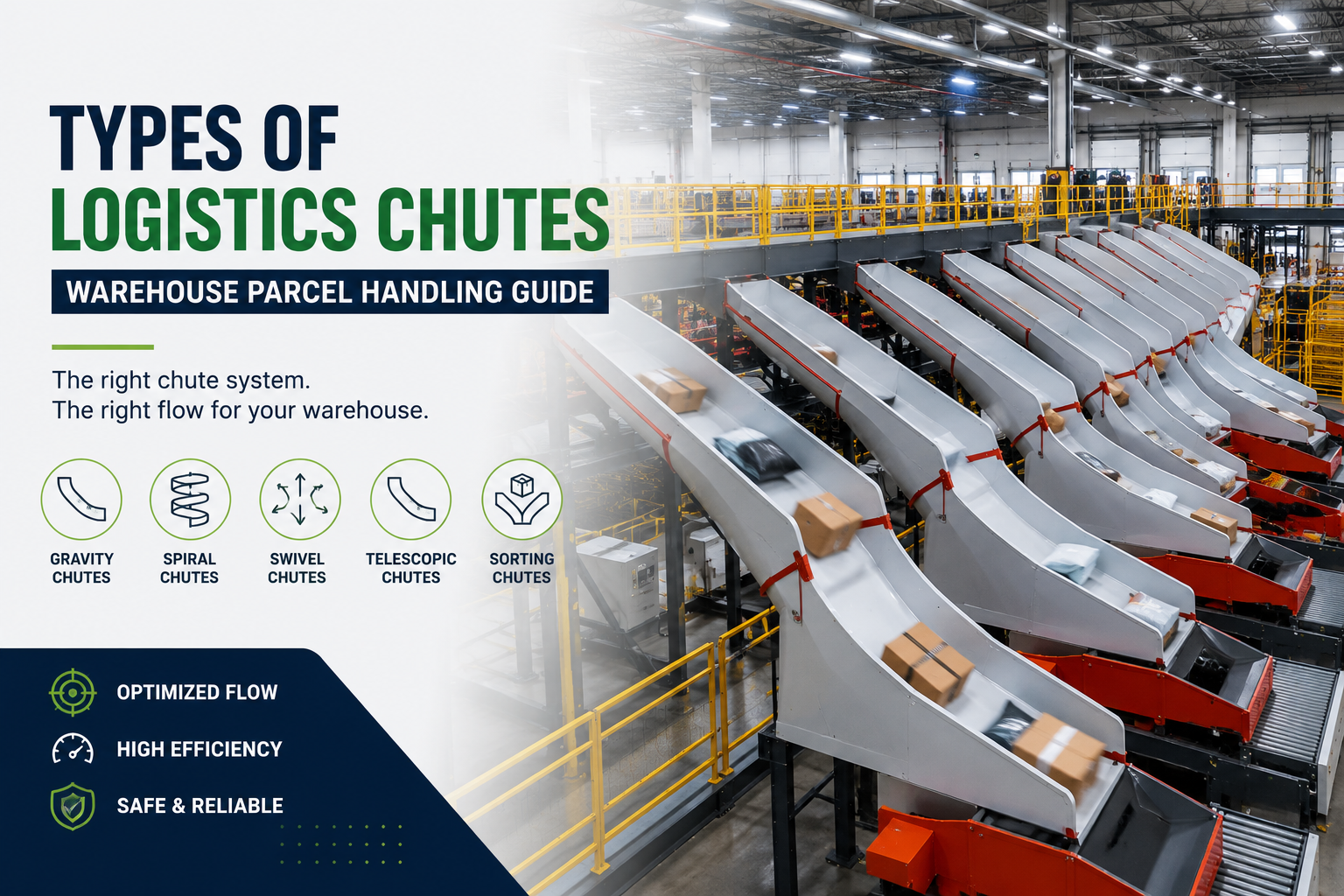
In today’s fast-paced e-commerce and logistics landscape, every second counts. When parcels and cartons need to move between warehouse levels, conveyor lines, or sorting stations, the right logistics chute can make the difference between a bottleneck and a seamless flow.
At Guangdong Guosheng Intelligent Equipment Co., Ltd., we design and manufacture a full range of warehouse chute solutions — each engineered for specific operational needs, from heavy-duty industrial environments to delicate pharmaceutical handling. In this guide, we break down all five types of chutes in our product line, so you can choose the best fit for your facility.
1. Carbon Steel Chute — Heavy-Duty Industrial Workhorse

The Carbon Steel Chute is built for strength and longevity. Its robust carbon steel construction handles continuous, high-volume parcel flow in demanding industrial environments. Whether you are moving cartons, totes, or irregularly shaped goods, this chute delivers reliable gravity-fed performance day after day.
- Material: Carbon steel — exceptional tensile strength
- Transport method: Gravity-fed slide conveyor
- Best for: Heavy-duty industrial logistics, high-volume e-commerce fulfillment
- Key advantage: Customizable surfaces, widths, angles, and conveyor interfaces
If your operation moves large volumes of parcels through a multi-level warehouse, the carbon steel chute provides the durability and consistent flow you need to avoid jams and downtime.
2. FRP Spiral Chute — Lightweight and Corrosion-Resistant
The FRP Spiral Chute uses glass-reinforced plastic (fiberglass) to achieve a unique combination of strength, light weight, and corrosion resistance. This makes it an ideal spiral chute for environments where traditional metal chutes would degrade — such as cold chain logistics, pharmaceutical facilities, and food-grade handling areas.
- Material: Glass-reinforced plastic (FRP)
- Capacity: Up to 6,000–10,000 parcels per hour
- Configuration: Single-tier or multi-tier spiral
- Key advantage: Smooth surface for gentle handling of fragile goods
The FRP spiral chute is also lightweight and modular, which means faster installation and lower structural support requirements compared to all-steel alternatives. For facilities handling smaller, lighter, or fragile parcels that need a soft landing, this is often the top choice.
3. Logistic Spiral Chute — High-Speed Vertical Flow
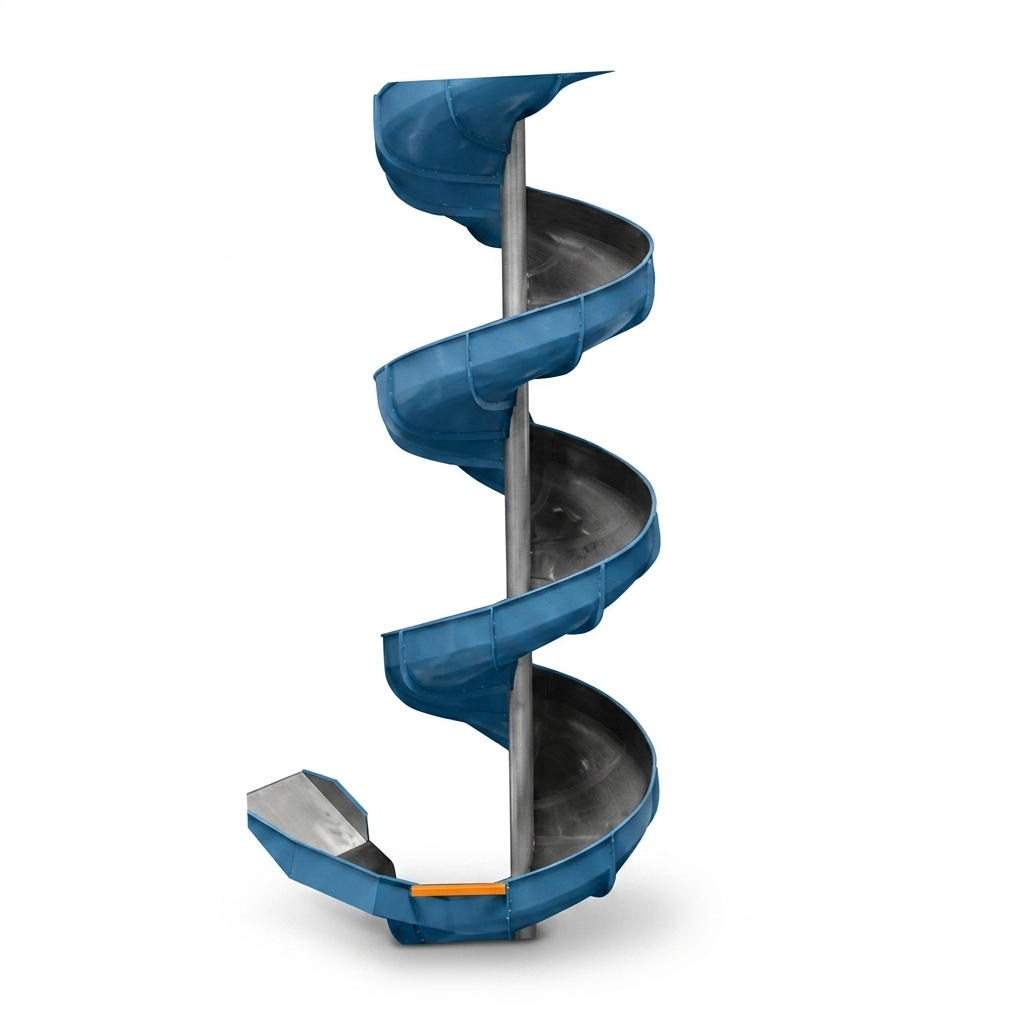
When throughput is your top priority, the Logistic Spiral Chute is the answer. This gravity-fed spiral conveyor moves parcels, cartons, and lightweight goods smoothly between different heights while minimizing the equipment footprint.
- Capacity: Up to 6,000–10,000 parcels per hour
- Material options: Stainless steel, carbon steel, or low-friction composites
- Configuration: Single-tier or multi-tier spiral
- Key advantage: Optional barcode scanners, RFID tracking, and motorized rollers
What sets the logistic spiral chute apart is its integration potential. You can add barcode scanners, RFID readers, and motorized rollers directly into the chute structure, turning a passive gravity slide into an active part of your warehouse automation system. The smooth spiral curvature also reduces parcel damage — a critical factor when handling customer orders.
4. Curved Chute — Smart Corner Routing for Tight Spaces
Not every warehouse has the luxury of straight-line layouts. The Curved Chute solves this problem by routing parcels around corners and through constrained spaces without sacrificing flow speed or reliability.
- Material options: Carbon steel, FRP, or stainless steel
- Transport method: Gravity-fed curved slide
- Best for: Corner routing and multi-level parcel flow in constrained layouts
- Key advantage: Fully customizable radius, angle, width, and height
The curved chute can be manufactured from your choice of material to match your facility’s environmental conditions — carbon steel for heavy loads, FRP for corrosion resistance, or stainless steel for hygiene-critical applications. Its compact modular structure makes it easy to integrate into existing conveyor systems, even in older buildings with limited floor space.
5. Straight Chute — Simple, Reliable Parcel Transfer
Sometimes the simplest solution is the best one. The Straight Chute is a no-nonsense, gravity-fed slide designed for fast and gentle parcel transfer between warehouse levels or process zones. It’s the most cost-effective option for straightforward point-to-point routing.
- Material options: FRP or stainless steel
- Transport method: Gravity-fed straight slide
- Best for: Parcel and carton transfer between levels
- Key advantage: Low-maintenance design with conveyor and automation compatibility
The straight chute is purposefully simple — easy to install, easy to maintain, and easy to customize. Whether you need to bridge a gap between two conveyor belts or create a drop zone from an upper mezzanine, this chute gets the job done with minimal complexity.
How to Choose the Right Warehouse Chute for Your Operation
Selecting the right logistics chute comes down to answering a few key questions about your operation:
| If you need… | Choose |
|---|---|
| Maximum durability for heavy cartons | Carbon Steel Chute |
| Corrosion resistance for cold chain or pharma | FRP Spiral Chute |
| High throughput with smart integration options | Logistic Spiral Chute |
| Corner routing in tight warehouse spaces | Curved Chute |
| Simple, low-cost point-to-point transfer | Straight Chute |
Why Guangdong Guosheng Chutes?
As a leading intelligent logistics equipment manufacturer, Guangdong Guosheng brings decades of engineering experience to every chute we produce. Our warehouse chute systems are:
- Fully customizable — dimensions, materials, angles, and interfaces tailored to your facility
- Modular by design — easy to install, expand, or reconfigure as your operation grows
- Integration-ready — compatible with automated sorters, belt conveyors, roller conveyors, and vertical lifts
- Built to last — quality materials and manufacturing ensure years of reliable service
Every chute in our product line is designed with one goal: keep your parcels flowing smoothly from intake to dispatch.
Conclusion
Choosing the right logistics chute is a strategic decision that impacts throughput, parcel damage rates, and overall warehouse efficiency. Whether you need the heavy-duty strength of carbon steel, the corrosion resistance of FRP, the smart integration of a logistic spiral, the space-saving design of a curved chute, or the simplicity of a straight chute — Guosheng has a solution engineered for your needs.
Ready to optimize your parcel flow? Contact our team today to discuss your requirements, or browse the full chute product line to learn more about each model.
Frequently Asked Questions
Q: What is a logistics chute?A: A logistics chute (also called a gravity chute or slide conveyor) is an inclined surface that uses gravity to move parcels, cartons, and goods between different heights in a warehouse or distribution center. Chutes are a cost-effective alternative to powered conveyors for vertical parcel transfer. Q: How many parcels per hour can a spiral chute handle?
A: Guosheng spiral chutes typically handle 6,000 to 10,000 parcels per hour, depending on the model, configuration (single-tier or multi-tier), and parcel characteristics. Custom configurations can be designed for higher throughput requirements. Q: What material should I choose for my warehouse chute?
A: It depends on your operating environment. Carbon steel offers maximum strength for heavy industrial use. FRP (fiberglass) provides corrosion resistance ideal for cold chain, pharmaceutical, and food-grade applications. Stainless steel is best for hygiene-critical or washdown environments. Q: Can chutes be integrated with existing conveyor systems?
A: Yes. All Guosheng chutes are designed with modular interfaces that connect to belt conveyors, roller conveyors, automated sorters, and vertical lifts. Dimensions, angles, and connection points are fully customizable to match your existing equipment. Q: What is the difference between a straight chute and a spiral chute?
A: A straight chute is a simple inclined slide for direct point-to-point parcel transfer — best for short distances and simple layouts. A spiral chute wraps around a central axis, allowing parcels to descend multiple levels within a compact footprint — best for multi-story facilities with space constraints.
Warehouse Chute Types: Quick Selection Table
When people ask about a chute in a warehouse or the right chute type, the useful answer starts with the parcel flow and building layout. Use this high-level comparison before confirming a final configuration with an engineering review.
| Chute type | Best for | Space and material consideration | Start here |
|---|---|---|---|
| Carbon steel chute | Heavy-duty industrial parcel and goods transfer | Strong structure for demanding warehouse workflows | View carbon steel chute |
| FRP spiral chute | Lightweight or fragile parcels and corrosion-sensitive environments | Spiral path helps use vertical space efficiently | View FRP spiral chute |
| Logistic spiral chute | Vertical parcel flow with a compact footprint | Review infeed, discharge, and integration conditions | View logistic spiral chute |
| Curved chute | Routing around corners or constrained layouts | Plan the turn radius and discharge direction | View curved chute |
| Straight chute | Direct gravity transfer between aligned points | Best where the transfer path is simple and linear | View straight chute |
Warehouse Chute FAQ
What are the main types of chutes used in warehouses?
Common warehouse chute types include carbon steel, FRP spiral, logistic spiral, curved, and straight chutes. The right option depends on parcel handling needs, elevation change, footprint, and the required equipment interfaces.
How do I choose a chute for warehouse parcel handling?
Start with parcel size and weight, the required vertical or horizontal route, peak flow, installation space, handling care, and the connection to conveyors or sorting equipment.
Can a warehouse chute be integrated with an automated sorting system?
Yes. A chute can be planned as part of a wider material-handling flow that includes conveyors, scanning points, and sorting equipment.