
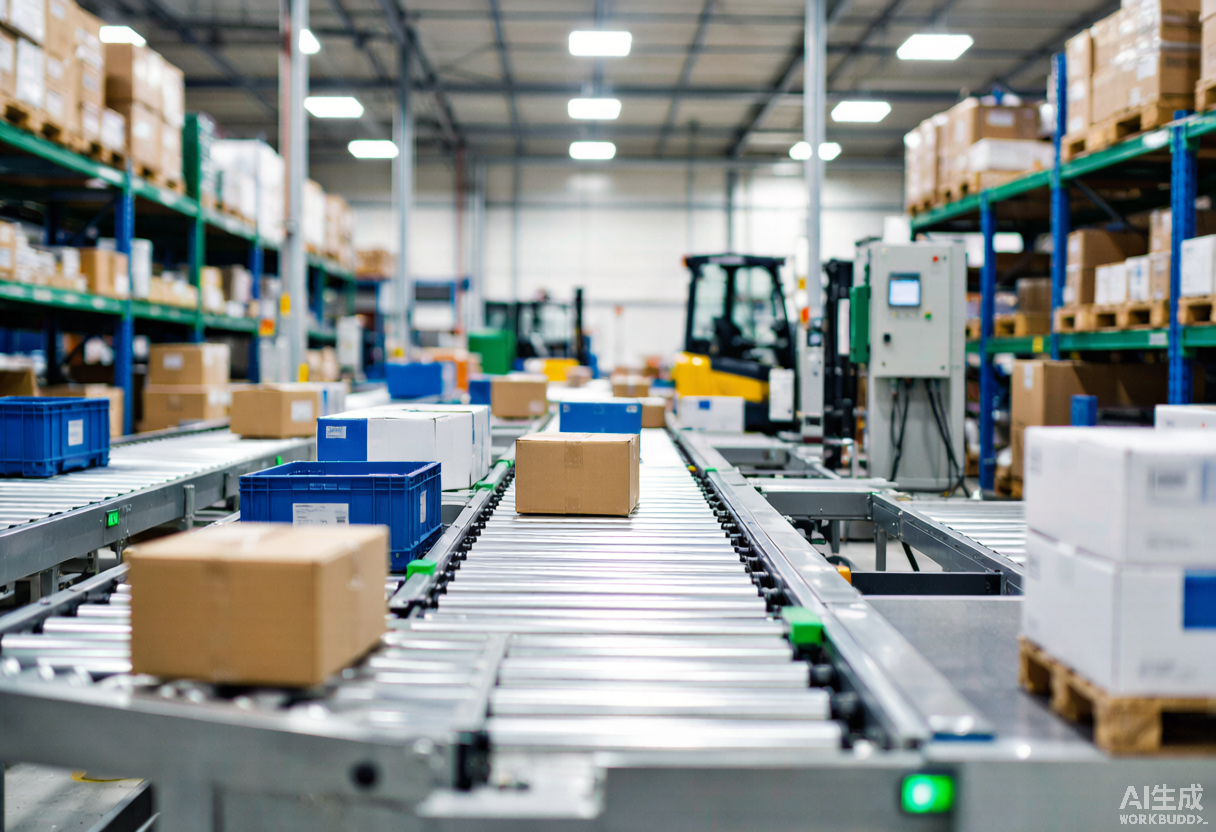
A roller conveyor system moves cartons, totes, and parcels on a bed of rotating rollers — a simple, efficient, and durable solution that powers warehouses around the world. Whether gravity-driven or motorized, roller conveyors handle flat-bottomed goods reliably and are among the most cost-effective conveyor options available.
Guosheng manufactures a complete line of roller conveyor solutions. This guide covers the types, applications, and how to choose the right system for your facility.
Types of Roller Conveyor Systems
1. Straight Roller Conveyor
Le Convoyeur à rouleaux droit provides stable, smooth conveying along a straight line — the fundamental building block of most warehouse conveyor networks.
2. Powered Roller Conveyor
Le Convoyeur à rouleaux motorisé uses motor-driven rollers for automated transport across warehouses and production lines. It handles 50–2,000 kg/m at speeds of 10–60 m/min, with motorized, belt-driven, or chain-driven options.
3. Curve Roller Conveyor
Le Convoyeur à rouleaux courbes transfers goods smoothly around corners, connecting straight sections in compact layouts.
4. Telescopic Roller Conveyor
Le Convoyeur à rouleaux télescopique is a flexible gravity roller system that extends for truck loading and unloading, handling 50–120 kg/m with adjustable height.
5. Spiral Gravity Roller Conveyor
Le Convoyeur à rouleaux en spirale par gravité is a non-powered spiral that moves goods down between levels in a compact footprint — ideal for warehouses and factories.
6. Specialty Roller Conveyors
Guosheng also offers centering, side alignment, skewed, et pop-up transfer roller conveyors for automatic product alignment, right-angle transfers (up to 1,500 kg pallet / 50 kg carton), and specialized routing.
Roller vs Belt Conveyor: Quick Note
Roller conveyors are generally preferred for flat-bottomed, rigid goods like cartons and totes, offering lower cost and easier maintenance than belts. Belt conveyors are better for irregular, flexible, or small items that might slip between rollers. Many facilities use both in combination.
How to Choose a Roller Conveyor System
- Gravity or powered? Gravity suits light loads and downward flow; powered suits automation and speed control.
- Load per meter — match roller spacing and material to your heaviest items (powered models handle up to 2,000 kg/m).
- Path — straight, curve, spiral, or telescopic sections to match your layout.
- Intégration — connect to sorters, transfers, and WCS for full automation.
Conclusion
Roller conveyor systems are the reliable, economical workhorses of warehouse automation — moving cartons and totes efficiently whether gravity-fed or powered. From straight lines to spiral drops and right-angle transfers, Guosheng’s roller conveyor line covers every application.
Building a conveyor network? Contacter Guosheng ou découvrez l'intégralité de la roller conveyor product range.
Foire aux questions
Q: What is a roller conveyor system?
A: A roller conveyor system transports goods on a bed of rotating rollers, either gravity-driven or powered by motors. It is used in warehouses to move cartons, totes, and parcels along straight, curved, or spiral paths.
Q: What is the difference between gravity and powered roller conveyors?
A: Gravity roller conveyors use slope and gravity to move goods with no power, ideal for light loads and downward flow. Powered roller conveyors use motor-driven rollers for controlled, automated transport — including uphill or level movement — with higher capacity.
Q: How much weight can a roller conveyor carry?
A: Guosheng powered roller conveyors handle 50–2,000 kg/m depending on configuration. Telescopic roller conveyors handle 50–120 kg/m, and specialty pop-up transfer units handle up to 1,500 kg for pallets.