
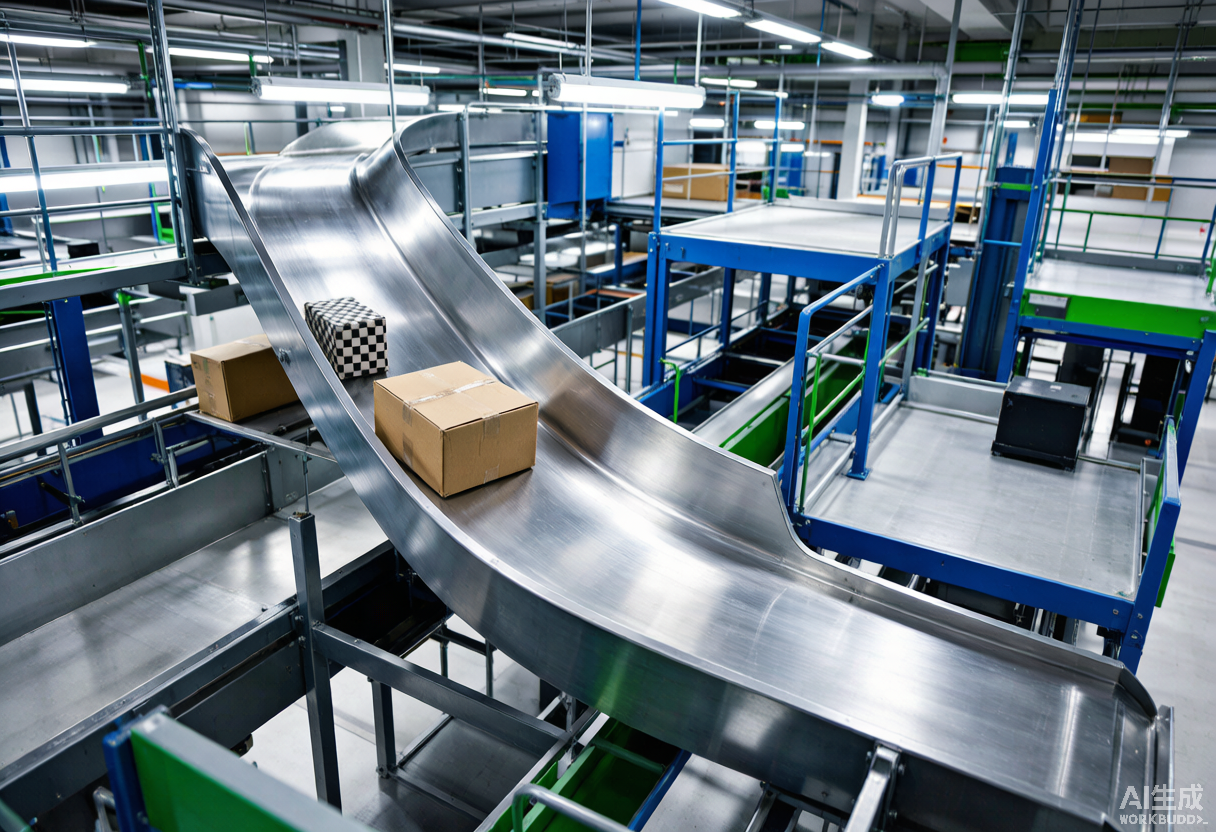
When a parcel needs to move from an upper mezzanine to a lower level, the simplest solution is often a gravity chute. But should it be straight or curved? The answer comes down to your building’s layout, available floor space, and how the chute connects to your conveyor network.
Guosheng manufactures both: the Glissière droite and the Glissière courbe. Here is how to decide between them.
Straight Chute: Simple, Reliable Point-to-Point Transfer
Le Glissière droite is a simple inclined slide that moves parcels and cartons directly between two points — ideal for bridging a gap between conveyor belts or creating a drop zone from an upper level. It is available in FRP or stainless steel and requires virtually no maintenance.
- Idéal pour : straightforward point-to-point transfer
- Coût : the most economical chute option
- Installation: simple, fast, minimal support structure
- Entretien : low-maintenance gravity-fed design
Curved Chute: Smart Corner Routing for Tight Spaces
Le Glissière courbe routes parcels around corners and through constrained layouts, manufactured from carbon steel, FRP, or stainless steel to match the environment. Its compact modular structure is designed for multi-level warehouses where line geometry is constrained.
- Idéal pour : corner routing and constrained layouts
- Choix de matériaux : carbon steel, FRP, or stainless steel
- Customization: radius, angle, width, height, and conveyor interface
- Design: compact modular structure for multi-level layouts
Straight vs Curved Chute: Comparison
| Critère | Glissière droite | Glissière courbe |
|---|---|---|
| Mise en page | Direct incline, point-to-point | Corner routing, compact |
| Empreinte écologique | Needs straight-line space | Wraps corners, saves space |
| Matériaux | FRP ou acier inoxydable | Carbon steel, FRP, or stainless |
| Idéal pour | Simple transfers, budget projects | Constrained layouts, multi-level flow |
| Cost | Lower | Higher (custom geometry) |
Comment choisir
- If your parcel flow is straight-line and space is not an issue, choose the straight chute for simplicity and economy.
- If you need to route around corners or work within tight multi-level layouts, choose the curved chute.
- If you require specific materials (e.g., stainless steel for hygiene), confirm availability in both types — the curved chute offers more material options.
Conclusion
The choice between curved and straight chutes is really a choice about your warehouse layout. Straight chutes deliver simplicity and economy for direct transfers; curved chutes unlock corner routing and space-saving designs for constrained facilities. Both are gravity-fed, low-maintenance, and fully customizable to your parcel profile.
Planning a chute layout? Discutez avec les ingénieurs de Guosheng or browse the full chute product line, including spiral, carbon steel, and FRP options.
Foire aux questions
Q: What is the difference between a curved chute and a straight chute?
A: A straight chute is a direct inclined slide for point-to-point transfer, ideal for simple layouts. A curved chute routes parcels around corners and through constrained spaces, with a compact modular structure for multi-level warehouses.
Q: Are curved chutes more expensive than straight chutes?
A: Generally yes — curved chutes involve custom geometry and more material options, so they typically cost more than a simple straight chute. The premium buys corner-routing capability and space savings.
Q: What materials are available for chutes?
A: Guosheng straight chutes come in FRP or stainless steel; curved chutes come in carbon steel, FRP, or stainless steel. Carbon steel suits heavy industrial use, FRP suits corrosion-resistant environments, and stainless steel suits hygiene-critical operations.