
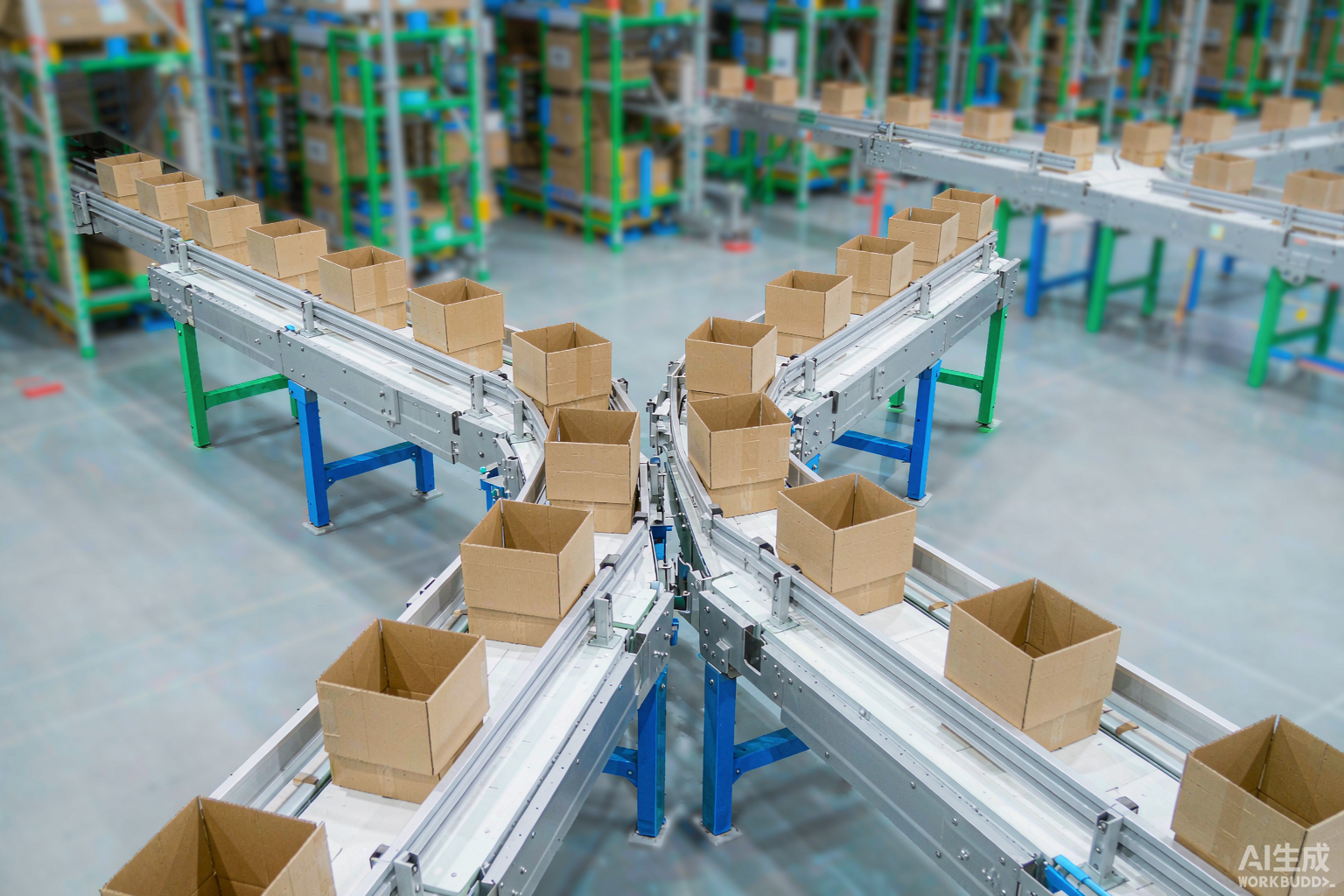
Your sorter can only run as fast as the stream feeding it. If parcels arrive on three separate lines at irregular intervals, a high-capacity sorter sits half idle — or worse, jams when two cartons arrive together. A narrow belt merging conveyor solves that problem: it combines multiple infeed lines into one controlled, evenly spaced single flow.
Merging is one of the least glamorous parts of a conveyor layout, and one of the most consequential. This guide covers how merge conveyors work, the design decisions that determine whether your sorter runs at capacity, and how to specify the Guosheng Narrow Belt Merge Conveyor.
What a Narrow Belt Merging Conveyor Does
A narrow belt merge conveyor uses parallel narrow belt modules to bring cartons, packages, and parcels from several conveyor lines into a single downstream flow. Instead of one operator manually combining streams, the conveyor merges them continuously and at speed — improving sorting efficiency and reducing manual handling cost.
The “narrow belt” construction is what makes precise merging possible: individual narrow belts can be controlled independently, so each incoming line can be released into the main flow at the right moment rather than colliding with its neighbour.
Why the Merge Determines Sorter Performance
- Gap control: a sorter needs consistent spacing between items — merging creates that rhythm
- Line utilization: multiple pick or packing lines can feed one high-capacity sorter
- Jam prevention: a controlled merge stops the double-arrivals that stall a sorter deck
- Labor reduction: no manual combining, sorting, or re-spacing at the infeed
In practice this means the merge should be designed together with the sorter, not bolted on afterwards. If you are still choosing the sorting technology itself, start with our overview of systèmes de tri automatisés or the sorter product range.
Design Decision 1: How Many Infeed Lines
The number of lines feeding the merge sets its geometry. Each additional infeed adds a merge point and increases the control complexity. Count your actual sources — packing stations, pick zones, receiving lines — and confirm the peak simultaneous rate from each, not just the average.
Design Decision 2: Merge Length and Angle
The length over which lines combine determines how much room each item has to accelerate and find its gap. A longer, gentler merge zone gives smoother release; a short merge saves floor space but demands tighter control. Conveyor width and length are both customizable on Guosheng units, so this is a layout decision rather than a fixed constraint.
Design Decision 3: Belt Speed and Control
Merge speed must be adjustable, because the correct speed changes with parcel mix and volume. Speed on the Guosheng narrow belt merge conveyor is adjustable, and drive type is selectable:
- Servo motor drive — precise positioning and timing where accurate gap control is critical
- Variable frequency drive (VFD) — smooth speed adjustment matched to line demand
If your merge feeds a sorter that routes lightweight mailers and cartons, the sorter’s own divert mechanism matters too — see our trieuse à bande étroite et trieur à courroies croisées pages for how each handles incoming flow.
Design Decision 4: Load and Belt Material
The Guosheng narrow belt merge conveyor handles loads of 5 à 50 kg — suited to parcels, cartons, and packages rather than pallets. Belt material is PVC or PU, and the frame is available in carbon steel or stainless steel:
- Carbon steel frame — standard warehouse environments
- Cadre en acier inoxydable — hygiene-critical or washdown areas, where a PVC/PU belt also helps with cleaning
Caractéristiques techniques
| Parameter | Specification |
|---|---|
| Type de convoyeur | Narrow belt merge conveyor |
| Belt material | PVC / PU |
| Conveyor width | Personnalisé |
| Conveyor length | Personnalisé |
| Vitesse | Réglable |
| Capacité de charge | 5 à 50 kg |
| Matériau du cadre | Carbon steel / stainless steel |
| Drive type | Motor driven (servo or VFD optional) |
| Tension | 220 V / 380 V |
Where Merge Conveyors Are Used
- Centres de traitement des commandes en ligne
- Systèmes de tri des colis de messagerie et de livraison express
- Projets d'automatisation des entrepôts
- Centres de distribution
- Systèmes logistiques automatisés
- Lignes de manutention des cartons
- Systèmes de convoyage pour l'intralogistique
The merge is one element of a wider belt conveyor layout — the straight, curve, and spiral sections that carry cartons to and from it are covered in the Gamme de convoyeurs à bande.
For hub-level sorting design, our courier and postal sorting hub guide covers how merges fit into a full inbound-to-dispatch flow.
Specification Checklist
- How many infeed lines must merge, and what is the peak rate from each?
- What is the heaviest parcel the merge must carry (Guosheng range: 5–50 kg)?
- How much floor length is available for the merge zone?
- What downstream speed must the merge match to keep the sorter fed?
- Is precise gap control needed (servo) or smooth speed matching (VFD)?
- Does the environment require a stainless steel frame?
- What control interface must connect the merge to your WMS/WCS?
For a broader requirements-gathering process, use our liste de contrôle pour la conception d'un système de convoyeur d'entrepôt.
Conclusion
The merge is where throughput is won or lost. A narrow belt merging conveyor gives you controlled, continuous combination of multiple infeed lines into one sorter-ready flow — with adjustable speed, selectable servo or VFD drive, and customizable width and length to fit your layout. Specify it alongside your sorter, and the downstream equipment finally runs at the capacity you paid for.
Designing sorter infeed? Contacter Guosheng with your infeed line count, parcel weights, and available floor length — our engineers will configure the merge and sorter feed as one system.
Foire aux questions
Q: What is a narrow belt merging conveyor?
A: A narrow belt merge conveyor uses parallel narrow belt modules to combine cartons, packages, and parcels from multiple conveyor lines into a single controlled flow. It is typically placed immediately before a sorter to keep items evenly spaced and prevent jams.
Q: How much weight can a narrow belt merge conveyor handle?
A: The Guosheng narrow belt merge conveyor handles loads of 5–50 kg, making it suitable for parcels, cartons, and packages. Heavier pallet loads require different conveyor types.
Q: Should I choose a servo motor or VFD drive for a merge conveyor?
A: Choose a servo motor where precise positioning and gap control are critical to sorter performance, and a variable frequency drive where smooth, adjustable speed matched to line demand is sufficient. Both are available on Guosheng merge conveyors.
Q: Can the merge conveyor be sized to my layout?
A: Yes. Conveyor width and length are both customizable, and frame material can be carbon steel or stainless steel. Speed is adjustable, and the unit runs on 220V or 380V supply.