
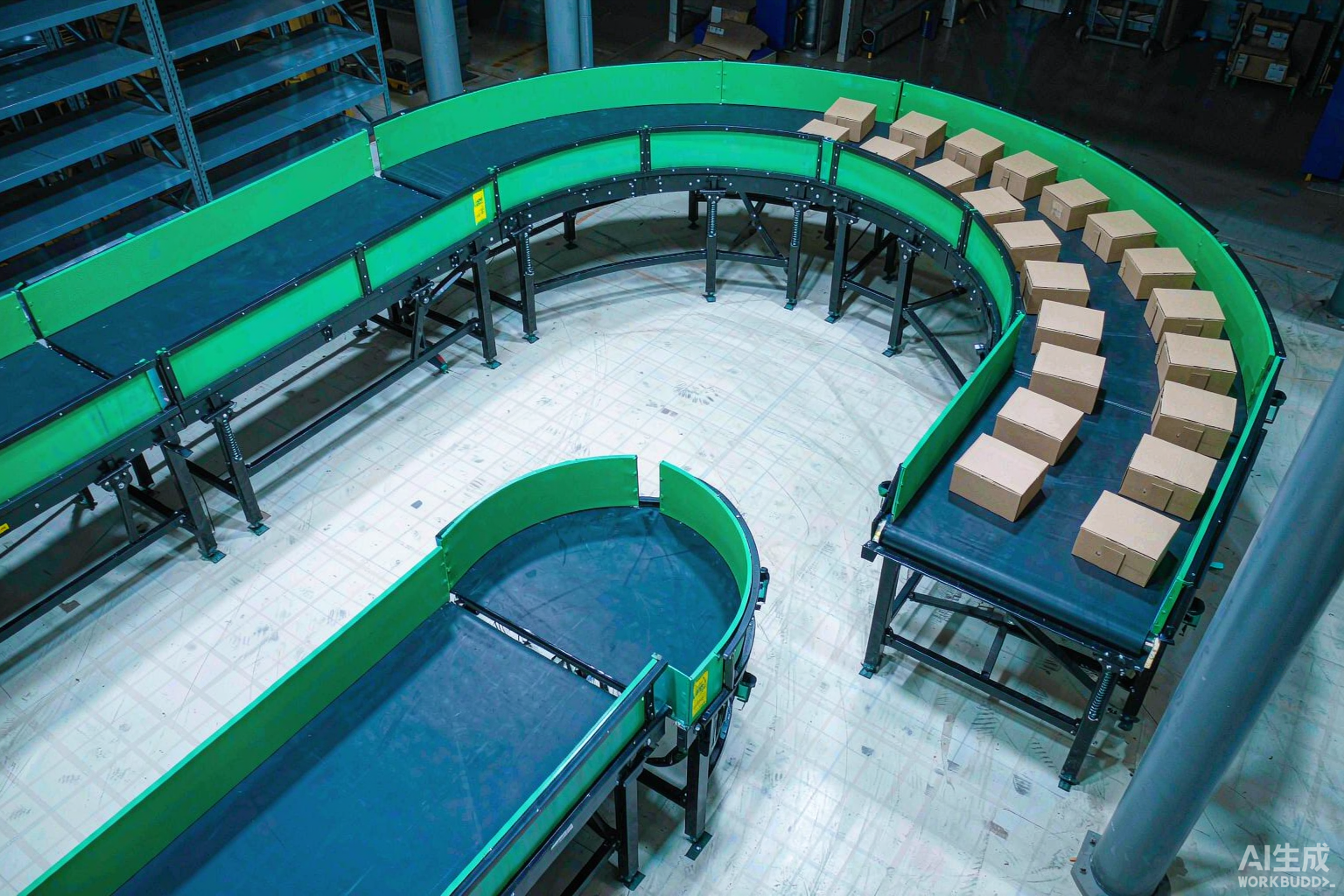
Straight runs are easy. The moment a conveyor line has to change direction — around a column, between aisles, or up to a mezzanine — the design gets complicated fast. A convoyeur à bande courbe solves that problem: it turns the flow smoothly while keeping product orientation intact, without manual transfer or reorientation.
But curves are not interchangeable. Get the radius, angle, or belt width wrong and you get jams, product spillage, or a curve that simply does not fit the floor plan. This guide walks through the specification decisions that matter, using the Guosheng Curve Belt Conveyor as the reference.
What a Curve Belt Conveyor Does
A curve belt conveyor is a belt conveyor built on a curved frame, allowing products to change direction continuously along the belt instead of stopping at a transfer point. The belt itself is manufactured to the curve geometry, so items ride from entry to exit without losing orientation.
- Directional change: 45°, 60°, 90°, 180°, and 360° spiral configurations
- Belt speeds: up to 550 feet per minute
- Inner radius: 150 mm to 1,500 mm (5.9″ to 59″)
- Belt widths: customizable, commonly 34″ and 42″ standard sizes
- Châssis : powder-coated steel, with stainless steel optional
- Belt material: PVC, urethane, or rubber depending on application
Decision 1: Turn Angle
The turn angle is dictated by your layout, not by preference. A 90° curve handles the typical right-angle corner between two aisles. A 180° curve reverses flow direction. Full 360° spiral configurations combine a direction change with an elevation change — useful when you need vertical movement in a tight footprint.
Practical point: standard angles (45°, 60°, 90°, 180°) are usually the most economical choice. If your layout demands an unusual angle, confirm with engineering early — it may change the frame design and lead time.
Decision 2: Inner Radius vs Product Size
Inner radius is the constraint most often overlooked. Available from 150 mm to 1,500 mm, the radius must be large enough that your longest products can navigate the curve without binding at the inner edge or swinging wide at the outer edge.
- Long items need a larger inner radius relative to their length
- Tight radii save floor space but risk jamming long or rigid products
- Confirm your maximum product length against the proposed radius before ordering
A good rule of thumb for discussion with your engineer: the product must be able to span the curve geometry without one end leaving the belt path. If your product mix includes both small parcels and long cartons, say so upfront — the curve has to accommodate the worst case, not the average.
Decision 3: Belt Width
Belt width determines what fits and how stable products are on the curve. Guosheng curves are customizable, with 34″ and 42″ as common standard sizes. On a curve, product stability matters more than on a straight run — lateral forces push items toward the outer edge.
- Add margin beyond your widest product so items are not riding the belt edge
- Wider belts increase frame size and cost — do not over-specify
- Match width to the adjoining straight conveyors so transfers stay aligned
Decision 4: Belt Material
Belt material follows the application, not the conveyor geometry:
- PVC — general-purpose handling of cartons and packaged goods
- Urethane — where a different grip or resistance profile is needed
- Rubber — heavier-duty applications
For food and beverage applications that need hygienic transport and washdown capability, belt material and the optional stainless steel frame become the deciding factors. If your operation is temperature-controlled or hygiene-critical, read our cold chain conveyor guide before finalizing material choice.
Safety and Maintenance Features
Curves introduce lateral movement that straight runs do not, so guarding matters:
- Guard sides prevent product spillage at the curve
- Backstops stop products from rolling backward on inclined or spiral configurations
- Emergency stops support safe operator intervention
- Modular design allows quick belt changes — in some cases completed in as little as 15 minutes — minimizing downtime
Where Curve Belt Conveyors Fit
- Airports — baggage handling between terminals and aircraft
- E-commerce fulfillment — high-speed package routing in distribution centers
- Centres de distribution — moving goods through complex layouts from receiving to shipping
- Food and beverage — hygienic transport, sometimes with washdown
- Parcel post and courier — redirecting parcels within sorting facilities
- Manufacturing and packaging — integration into production lines
If your curve also needs to change elevation, compare it against the convoyeur à bande en courbe hélicoïdale, which handles total loads up to 1,600 kg with conveying speeds up to 60 m/min. For the broader picture of belt options, see the Gamme de convoyeurs à bande et notre belt conveyor systems guide.
Specification Checklist
- What is the required turn angle, and is it a standard or custom geometry?
- What is the longest product that must pass through the curve?
- What inner radius does that product need, and does it fit the available floor space?
- What belt width accommodates your widest product with margin to spare?
- Which belt material suits your product, hygiene, and washdown requirements?
- What speed must the curve match to stay synchronized with adjoining conveyors?
- What guarding, backstops, and emergency stops does your site require?
Conclusion
A curve belt conveyor is one of the highest-leverage components in a conveyor layout: get it right and flow stays continuous through the tightest parts of your facility. Specify the turn angle from your layout, the inner radius from your longest product, the belt width from your widest product, and the belt material from your application — then confirm speed and guarding against the adjoining lines.
Designing a curved section? Contacter Guosheng with your angle, product dimensions, and floor plan — our engineers will confirm the right curve belt conveyor configuration before you order.
Foire aux questions
Q: What is a curve belt conveyor used for?
A: A curve belt conveyor changes the direction of products being transported — typically 45°, 60°, 90°, 180°, or 360° spiral configurations — allowing continuous flow around corners without manual transfer. It maintains product orientation and optimizes facility layout.
Q: What inner radius do curve belt conveyors come in?
A: Guosheng curve belt conveyors are available with inner radii from 150 mm to 1,500 mm (5.9″ to 59″). The right radius depends on the longest product that must pass through the curve.
Q: How fast can a curve belt conveyor run?
A: Belt speeds go up to 550 feet per minute. The actual speed should be set to match the adjoining straight conveyor sections so products transfer smoothly without gaps or collisions.
Q: Can a curve belt conveyor handle heavy or irregular products?
A: Yes. Curve belt conveyors handle cartons, pallets, irregularly shaped objects, and bulky goods, with frames built in powder-coated steel for heavy-duty continuous operation and stainless steel as an option for hygiene-critical environments.