
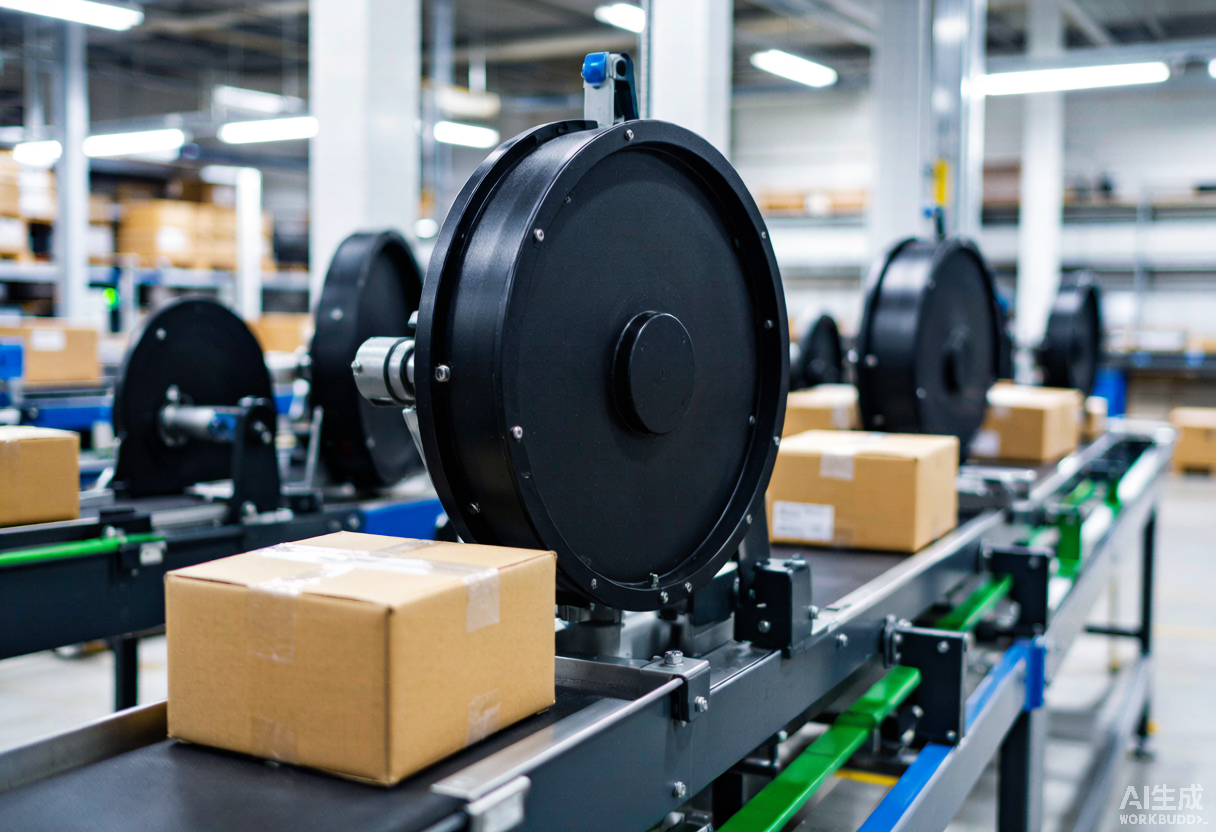
When it comes to automated parcel sorting, two technologies dominate the conversation: the cross-belt sorter and the wheel sorter. Both route parcels to their correct destinations automatically, but they achieve this through fundamentally different mechanisms — and each has strengths that suit different operations.
In this guide, we compare the two head-to-head using Guosheng’s actual products — the Trieuse à bandes croisées and the wheel-based sorters including the Trieuse à roues à courroie en O, Trieuse à roues pivotantes, et Trieuse à roues rotatives.
Fonctionnement d'un trieur à bandes croisées
A cross-belt sorter uses individual belt carriers mounted on a main conveyor chain. Each carrier belt runs perpendicular to the direction of travel, allowing it to discharge a parcel left or right into a sorting chute or takeaway conveyor without stopping the main line.
- Capacité : Jusqu'à 10 000 colis par heure
- Idéal pour : Colis de petite taille, de taille moyenne et légers
- Handling: Gentle — each parcel travels on its own belt
- Intégration : WMS, WCS, DMS, barcode, and RFID ready
How a Wheel Sorter Works
A wheel sorter uses rows of rotating wheels (O-belt, pivoting, or turntable configurations) that change direction on demand to divert parcels at angles from 30 to 60 degrees — or up to 360 degrees with a turntable mechanism.
- Capacité : 4,000–8,000 parcels per hour depending on model
- Poids du colis : Up to 30 kg (O-belt) or 60 kg (swing arm / turntable)
- Angles de déviation : 30, 45, 60 degrés ou sur mesure
- Footprint: Compact, space-efficient designs
Cross-Belt vs Wheel Sorter: Key Differences
| Critère | Trieuse à bandes croisées | Wheel Sorter |
|---|---|---|
| Max capacity | 10,000 parcels/hr | 4,000–8,000 parcels/hr |
| Max parcel weight | Colis légers | Up to 30–60 kg |
| Divert angle | Left/right discharge | 30–60° or 360° (turntable) |
| Empreinte écologique | Compact for its capacity | Very compact |
| Cost | Plus élevé | Lower to mid |
| Idéal pour | Extreme throughput hubs | Mid-volume, heavier parcels, tight spaces |
Which One Should You Choose?
Choose a cross-belt sorter if…
- You need maximum throughput — approaching 10,000 parcels per hour
- Your parcels are small to medium and lightweight
- You operate a large distribution hub with many sorting destinations
Choose a wheel sorter if…
- Your parcels are heavier (up to 30–60 kg)
- You have limited floor space and need a compact layout
- You need flexible divert angles and lower capital investment
- You want a low-noise option for noise-sensitive facilities
Conclusion
Both cross-belt and wheel sorters are proven technologies. Cross-belt sorters win on sheer throughput for large e-commerce and parcel hubs, while wheel sorters offer a smarter fit for mid-volume operations, heavier parcels, and space-constrained facilities. Define your parcel profile and peak volume, and the right technology becomes clear.
Need help choosing? Talk to our sorting engineers or browse the full automated sorting system product line to compare specifications side by side.
Foire aux questions
Q : Quelle est la différence entre un trieur à bandes croisées et un trieur à roues ?
A: A cross-belt sorter uses individual belt carriers to discharge parcels left or right at very high speeds (up to 10,000/hr), ideal for lightweight parcels. A wheel sorter uses rotating wheel modules to divert parcels at angles, handling heavier items (up to 60 kg) in a more compact footprint.
Q: Which sorter is faster, cross-belt or wheel?
A: Cross-belt sorters are typically faster in throughput, reaching up to 10,000 parcels per hour, while wheel sorters handle 4,000–8,000 per hour depending on the model and configuration.
Q: Can a wheel sorter handle heavy parcels?
A: Yes. Guosheng wheel sorters handle parcels up to 30 kg (O-belt model), while the swing arm and turntable wheel sorters support up to 60 kg per item — significantly more than a typical cross-belt sorter.