
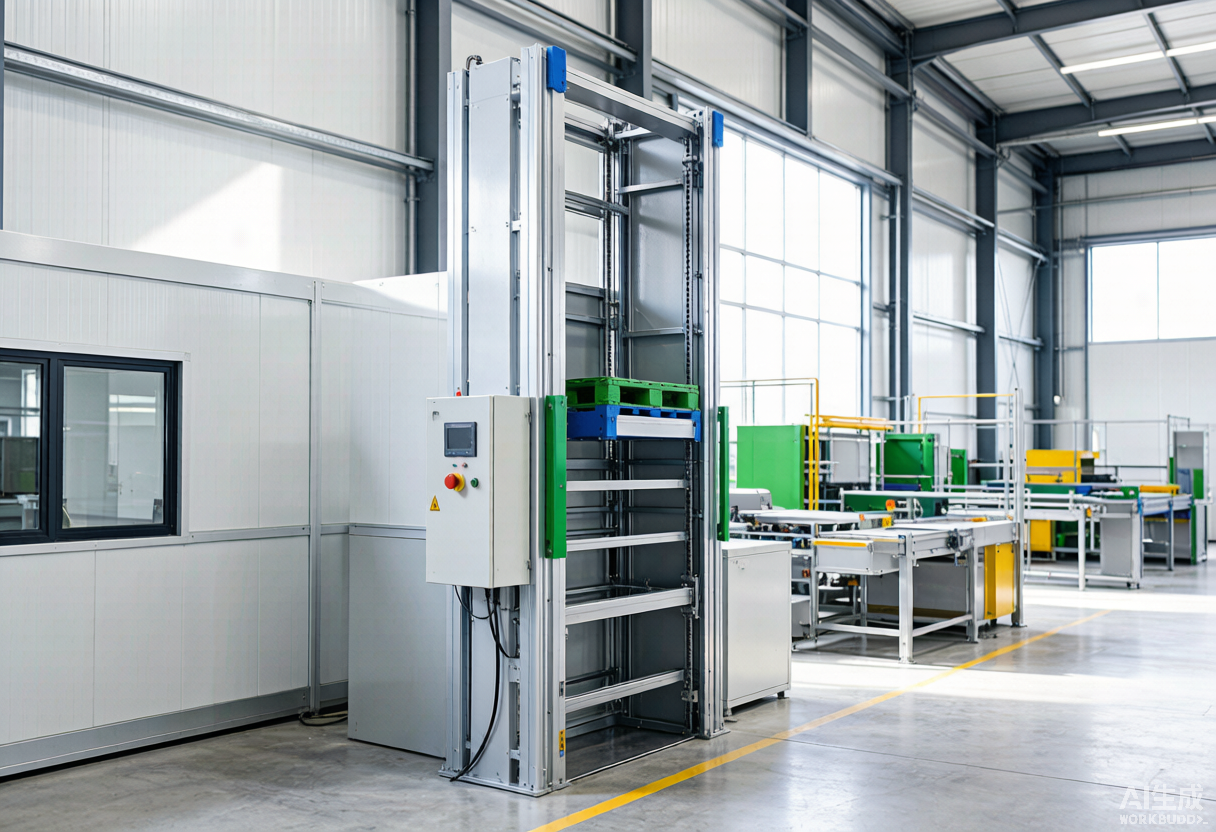
Two of the most common powered vertical lifts are the Vertical Reciprocating Conveyor (VRC) and the Continuous Vertical Conveyor. Both move goods between floors automatically, but they are built for different jobs. Choosing correctly can save you both money and frustration.
Guosheng manufactures both — the Vertical Reciprocating Conveyor and the Continuous Vertical Conveyor. Here is how they compare.
How a VRC Works
A VRC uses a reciprocating lifting platform that travels up and down between levels, carrying a load (or batch) on each cycle. It is essentially a freight lift designed for automated material handling — robust, safe, and capable of carrying heavy loads including pallets.
- Load: cartons, pallets, totes — heavy loads
- Flow: batch, one platform cycle at a time
- Safety: gates, interlocks, and full platform support
- Best for: pallets, heavy items, lower-frequency flow
How a Continuous Vertical Conveyor Works
A continuous vertical conveyor moves items in a continuous stream — carriers or platforms circulate endlessly, carrying cartons and totes up or down with minimal gaps. It maximizes throughput for lighter goods.
- Load: cartons, totes, parcels — lighter goods
- Flow: continuous, high volume
- Speed: adjustable, constant stream
- Best for: high-throughput carton and tote flow
VRC vs Continuous Vertical Conveyor: Comparison
| Criterion | VRC | Continuous Vertical Conveyor |
|---|---|---|
| Flow | Batch (platform cycle) | Continuous stream |
| Load type | Cartons, pallets, totes | Cartons, totes, parcels |
| Heavy loads | Excellent (pallets) | Light to medium |
| Throughput | Moderate (cycle-based) | High (continuous) |
| Footprint | Vertical shaft + platform | Compact vertical loop |
| Cost | Mid-high | Mid |
Which One Should You Choose?
Choose a VRC if…
- You move pallets or heavy items between floors
- Your flow is batch-oriented rather than continuous
- You need maximum load safety with platform support
Choose a continuous vertical conveyor if…
- You move cartons and totes in high volume
- You need a constant stream synchronized with conveyor lines
- Space is tight and you want a compact vertical loop
Conclusion
Choose a VRC when you need to lift heavy, palletized loads safely between floors in batches. Choose a continuous vertical conveyor when you need high-throughput, continuous flow of cartons and totes. And if you handle both, Guosheng can design a combined solution. For the full picture of vertical transport options, see our spiral chute vs vertical conveyor guide.
Ready to lift your warehouse to the next level? Contact Guosheng for a vertical conveyor recommendation based on your load profile and throughput.
Frequently Asked Questions
Q: What is a VRC conveyor?
A: A Vertical Reciprocating Conveyor (VRC) is a powered lift that moves cartons, pallets, and totes between floor levels using a reciprocating platform. It handles heavy loads safely in batch flow.
Q: What is the difference between a VRC and a continuous vertical conveyor?
A: A VRC moves loads in batches on a reciprocating platform, handling heavy items like pallets. A continuous vertical conveyor moves items in a continuous stream for higher throughput of lighter cartons and totes.
Q: Which vertical conveyor is best for pallets?
A: VRCs and fork-type vertical lifts are best for pallets, offering heavy load capacity and safe platform support. Continuous vertical conveyors are designed for lighter carton and tote flow.