
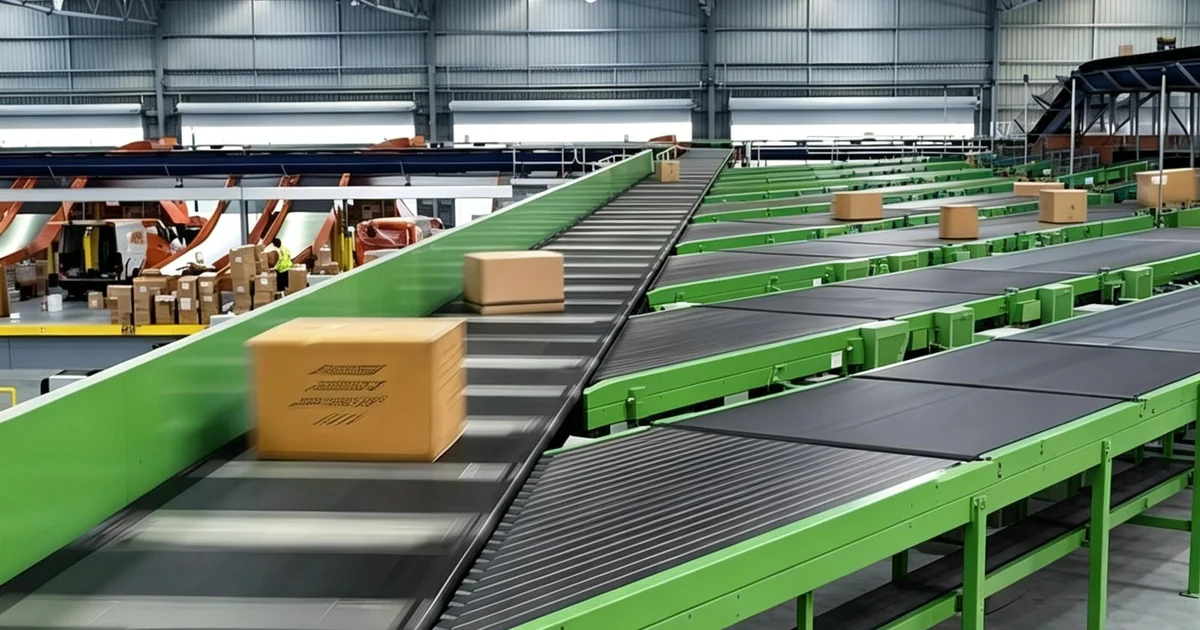
Cross-belt sorter systems are built for parcel operations that have outgrown manual sorting, simple diverters, or low-speed conveyor lanes. When daily order volume rises, the real challenge is not only moving parcels faster. The system must identify each item, keep it stable during transfer, discharge it to the right destination, and leave enough flexibility for new routes, SKUs, and peak-season volume.
For e-commerce fulfillment centers, parcel hubs, retail distribution centers, and 3PL warehouses, a cross-belt sorter can become the core of a high-speed sortation line. This guide explains how the technology works, where it fits best, what layout questions to answer before buying, and how to compare it with other automated sorter types.
What Is a Cross-Belt Sorter?
A cross-belt sorter is an automated sorting system that carries parcels on a series of short belt modules mounted across the main direction of travel. Each carrier moves along the sorter loop, while the belt on top can activate left or right to discharge the parcel into a chute, conveyor, bagging station, or other destination.
The result is a controlled, high-speed divert action. Instead of pushing a parcel from the side or relying on gravity alone, the sorter uses an active belt surface to transfer the item smoothly. That makes the system useful for mixed parcel streams that include cartons, poly mailers, envelopes, lightweight packages, and other items that need accurate destination handling.
Guosheng’s Cross-Belt Sorter is designed for high-speed parcel distribution, e-commerce fulfillment, logistics hubs, airport and postal sorting centers, and retail or FMCG distribution operations. It supports WMS, WCS, DWS, barcode scanning, and RFID integration depending on the project requirement.
Why Cross-Belt Sorters Fit High-Speed Parcel Sortation
A cross-belt sorter is usually considered when a warehouse needs both speed and destination density. The equipment can send parcels to many outlets from a compact loop or line layout, which helps facilities use floor space more efficiently than long manual sort aisles.
According to the Conveyor and Sortation Systems handbook overview from MHI’s Conveyor & Sortation Systems group, cross-belt sorters use individual motorized conveyor segments to propel loads off the sorter surface. In practical terms, that active discharge is the key difference. The belt can transfer the parcel with better control than many passive or impact-based methods.
For operators, the business benefits usually show up in five areas:
- Higher throughput: suitable for continuous parcel flow where manual sorting becomes a bottleneck.
- Accurate routing: barcode, RFID, DWS, or WCS logic can assign each parcel to the correct outlet.
- Gentle transfer: the active belt discharge helps reduce parcel impact and product damage.
- Compact layout: multiple discharge points can be arranged around a sorter line or loop.
- Scalable automation: modular design makes it easier to plan more destinations, infeed points, or software connections.
How a Cross-Belt Sorter Works
A complete cross-belt sorting line normally includes induction conveyors, parcel identification, the sorter body, discharge destinations, controls, and downstream handling equipment. The exact layout depends on parcel size, target throughput, destination count, and building conditions.
The process usually follows this sequence:
- Induction: parcels enter the line from conveyors, manual feeding stations, telescopic unloading lines, or upstream automation.
- Identification: barcode scanners, RFID, dimensioning, weighing, or manual data matching confirms the parcel destination.
- Carrier assignment: the control system assigns the parcel to a carrier or belt cell.
- Transport: the parcel travels along the sorter at controlled speed.
- Discharge: when the parcel reaches the correct outlet, the cross belt activates and transfers it to the selected chute, conveyor, sack, cage, or container.
- Reset: the carrier continues around the system and becomes available for the next item.
For a live project, these steps must be synchronized. If induction spacing is unstable, barcode read rates are poor, or discharge containers are not cleared in time, the sorter cannot deliver its rated performance. That is why the surrounding conveyors and data systems matter as much as the sorter itself.
Best Applications for a Cross-Belt Sorter
Cross-belt sorters are strongest in operations with many destinations, mixed parcel sizes, and high sorting volume. They are often used where the cost of wrong routing, manual labor, or repeated parcel handling is already significant.
Common applications include:
- E-commerce fulfillment: sorting customer orders by carrier, route, region, service level, or delivery wave.
- Parcel distribution hubs: handling outbound parcels across many line-haul, branch, or final-mile destinations.
- 3PL logistics warehouses: supporting multi-client operations where SKU profiles and outbound routes change often.
- Retail and FMCG distribution: routing cartons and lightweight packages to store groups or transport lanes.
- Postal and airport operations: sorting mail, parcels, and baggage-type items where accurate destination control is essential.
If your flow includes very heavy pallets, unstable open trays, unpacked irregular items, or large products that exceed carrier dimensions, a different handling method may be more suitable. For those projects, Guosheng may recommend a combination of belt conveyors, roller conveyors, transfer conveyors, and a sorter type matched to the real item profile.
Cross-Belt Sorter vs. Other Automated Sorter Types
No single sorter is best for every warehouse. A good selection process starts with parcel data and operating goals, then matches the sorter to the job.
| Sorter Type | Best Fit | Selection Notes |
|---|---|---|
| Cross-Belt Sorter | High-speed parcel hubs with many destinations | Strong for mixed parcels, controlled discharge, and scalable outlet layouts. |
| Pivoting Wheel Sorter | Cartons and parcels that can be diverted from a conveyor line | Efficient for common warehouse diverting and line branching. |
| Narrow Belt Sorter | Medium-speed sorting with modular conveyor integration | Useful where a compact belt-based sorter is enough for the destination count. |
| O-Belt Wheel Sorter | Parcel lines needing a flexible wheel-based diverting solution | Often considered for moderate throughput and adaptable line layouts. |
| Swing Arm Sorter | Simple sorting to fewer destinations | Lower complexity, but less suitable for very high-speed, dense-destination systems. |
In short, choose a cross-belt sorter when the project needs high throughput, many destinations, accurate discharge, and a professional automation platform for future growth. Choose a simpler sorter when the parcel stream is predictable, destination count is low, or budget and layout do not justify a high-capacity system.
Layout Questions to Answer Before Buying
The equipment quote should be based on real operating data, not only a rough idea of hourly volume. Before requesting a cross-belt sorter proposal, collect the following information:
- Throughput target: average parcels per hour, peak parcels per hour, and expected growth over the next three to five years.
- Parcel profile: length, width, height, weight range, packaging type, fragile items, and the percentage of polybags or irregular packages.
- Destination count: number of chutes, bags, cages, transport lanes, or downstream conveyors.
- Induction method: manual feed, automated conveyor feed, multiple induction points, or integration with unloading equipment.
- Data integration: WMS, WCS, DWS, scanner brand, barcode quality, RFID needs, and exception handling logic.
- Building limits: available footprint, ceiling height, column grid, fire exits, maintenance access, and operator walkways.
- Safety requirements: guarding, emergency stops, lockout points, noise limits, and local compliance requirements. OSHA’s warehousing safety overview is a useful starting point for recognizing common warehouse hazards during planning.
These details help the supplier size the sorter, select carrier dimensions, plan discharge spacing, design infeed conveyors, and estimate controls work. They also reduce the risk of buying a sorter that looks strong on paper but does not match the real site.
Technical Factors That Affect Performance
When comparing cross-belt sorter proposals, do not look only at maximum throughput. The quality of the whole system depends on mechanical design, controls, induction discipline, and service support.
Important factors include:
- Carrier and belt size: must match the largest regular parcel while maintaining enough carrier density for speed.
- Sorter speed: should balance throughput with stable parcel handling and safe operation.
- Barcode read rate: poor label placement or scanner layout can create recirculation and manual exception work.
- Discharge design: chutes, conveyors, and containers must accept parcels without jams or overflows.
- Controls architecture: WMS/WCS/DWS communication should support destination assignment, tracking, exceptions, and reporting.
- Maintenance access: operators need clear access to motors, belts, sensors, guards, and electrical cabinets.
- After-sales support: spare parts, remote support, installation guidance, and training reduce lifecycle risk.
Guosheng can customize dimensions, control logic, induction design, discharge lanes, and integration interfaces based on your site plan, parcel data, and throughput target. For buyers comparing systems, the best RFQ is a clear technical conversation rather than a one-line price request.
RFQ Checklist for a Cross-Belt Sorter Project
Use this checklist when preparing an inquiry:
- Current and target parcels per hour
- Parcel size and weight range, including the largest and smallest regular items
- Packaging mix: cartons, mailers, envelopes, bags, fragile goods, or irregular items
- Number of destinations now and expected future destinations
- Available layout drawing, building columns, ceiling height, and power supply
- Preferred induction style and number of infeed points
- WMS, WCS, DWS, barcode, RFID, or PLC integration requirements
- Required delivery timeline, installation support, and training expectations
If you do not yet have complete data, start with a rough site drawing and daily/peak volume. Guosheng’s engineering team can help turn those details into a practical sorter concept.
FAQ: Cross-Belt Sorter Selection
What is a cross-belt sorter used for?
A cross-belt sorter is used for high-speed parcel and package sorting in e-commerce fulfillment, parcel distribution, postal, airport, retail, and 3PL logistics operations.
When should a warehouse choose a cross-belt sorter?
Choose a cross-belt sorter when the operation needs high throughput, many destinations, controlled parcel discharge, and integration with WMS, WCS, barcode, RFID, or DWS systems.
Can a cross-belt sorter handle mixed parcel sizes?
Yes. A properly specified cross-belt sorter can handle small, medium, and lightweight parcels, including cartons and many packaged goods. The carrier size and line design should be selected from your real parcel profile.
What information is needed for a cross-belt sorter quote?
Useful RFQ information includes parcel dimensions and weight, target throughput, destination count, layout drawing, induction method, data integration needs, and any safety or building constraints.
Plan Your Cross-Belt Sorting System With Guosheng
A cross-belt sorter is a strategic investment, not just a conveyor purchase. The best system is designed around your parcel data, building layout, destination logic, and growth plan.
Explore Guosheng’s Automated Sorting Systems, review the Cross-Belt Sorter, or visit our services page to see how we support automation projects. To discuss your parcel flow and sorting goals, contact Guosheng for a customized solution.