Vertical conveyor system design is one of the most important decisions in a multi-level warehouse, fulfillment center, or production facility. When cartons, totes, parcels, or pallets need to move between floors, mezzanines, platforms, or different process heights, the wrong vertical handling method can waste floor space, slow the line, and create extra manual lifting.
A well-planned vertical conveyor can connect receiving, storage, picking, packing, sortation, and dispatch into one smoother material flow. This guide explains the main vertical conveyor types, how to compare them, what data to prepare before requesting a quote, and how Guosheng helps design custom lift conveyor solutions for warehouse automation.
What Is a Vertical Conveyor System?
A vertical conveyor system is equipment used to move goods automatically from one elevation to another. Unlike a passenger elevator, it is designed for materials, cartons, totes, packages, or pallets rather than people. In warehouse automation, vertical conveyors often connect floor-level conveyors with mezzanines, multi-floor storage areas, sortation platforms, production lines, and packaging zones.
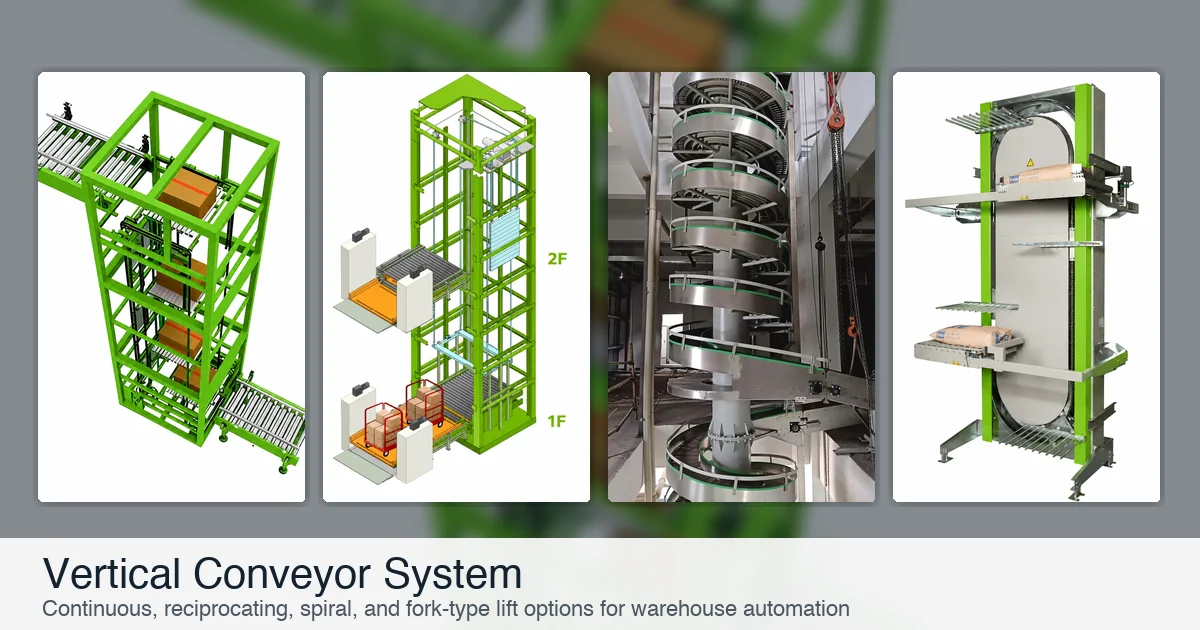
The right system depends on the load type, required throughput, lift height, available footprint, and how goods enter and leave the conveyor. Guosheng’s Băng tải đứng product line includes continuous vertical conveyors, vertical reciprocating conveyors, spiral chain conveyor systems, and fork type vertical lift conveyors for different warehouse layouts.
Why Vertical Conveyors Matter in Warehouse Automation
As warehouses add mezzanine storage, multi-floor picking, automated sorting, and dense conveyor networks, vertical movement becomes a constraint. Forklifts and manual carts can still be useful, but they often create traffic, waiting time, and labor dependency. A vertical conveyor system creates a fixed, repeatable material path that can be connected to upstream and downstream automation.
For operations teams, vertical conveyors can support several goals:
- Save floor space: move goods upward or downward without long inclined conveyors occupying large areas.
- Reduce manual lifting: automate repetitive vertical handling between floors or work levels.
- Improve flow consistency: connect conveyors, sorters, storage, packing, and dispatch with fewer interruptions.
- Support higher throughput: use continuous or automated lift cycles to handle more cartons, totes, or parcels.
- Increase layout flexibility: make better use of mezzanines, high platforms, and multi-level buildings.
Safety must be planned into the design. OSHA’s Materials Handling and Storage guidance notes conveyor hazards such as nip points, falling material, and the need for emergency stop devices and guarding. Those principles are especially important when conveyors pass near operators, aisles, platforms, and floor openings.
Main Types of Vertical Conveyor Systems
Different vertical conveyors solve different problems. A high-throughput parcel line needs a different design from a pallet handling lift or a compact mezzanine transfer point.
Băng tải thẳng đứng liên tục
A Băng tải thẳng đứng liên tục moves cartons, totes, parcels, or products continuously between levels. It is a strong fit when the process needs regular movement rather than occasional lifting. Because products can flow in a repeated sequence, continuous conveyors are useful for e-commerce fulfillment, logistics distribution, production lines, and parcel handling systems.
Choose this type when you need higher transportation efficiency, stable automated conveying, and a compact way to connect two or more operating levels.
Băng tải tịnh tiến dọc
A Băng tải tịnh tiến dọc, often called a VRC conveyor, uses a lifting platform to move loads up or down in cycles. It is commonly selected for cartons, pallets, totes, and heavier materials that do not need continuous flow every second.
MHI’s Vertical Reciprocating Conveyor explainer describes VRCs as material handling equipment used to improve operations through cost effectiveness, safety features, and vertical movement between levels. For warehouse planning, this makes VRCs practical when the site needs a controlled material lift with clear loading and unloading positions.
Hệ thống băng tải xích xoắn ốc
A Hệ thống băng tải xích xoắn ốc uses a spiral path to move cartons, packages, totes, or products between elevations while saving floor space. Spiral conveyors are often used in logistics centers, e-commerce warehouses, food and beverage lines, packaging areas, and manufacturing facilities.
Choose a spiral conveyor when continuous vertical transportation is needed but the building does not have enough space for a long incline conveyor. The spiral structure can provide smooth movement with a compact footprint.
Băng tải nâng thẳng đứng kiểu dĩa
A Băng tải nâng thẳng đứng kiểu dĩa is designed for automated pallet lifting and vertical material transfer. Its fork-type loading structure is useful for pallet handling, ASRS integration, manufacturing, industrial storage, and multi-floor material transportation.
Choose this type when the project involves pallets, heavier loads, or integration with automated storage and retrieval systems. The design conversation should include load dimensions, pallet condition, weight range, pickup method, and downstream transfer direction.
Vertical Conveyor Comparison Table
| Loại hệ thống | Phù hợp nhất cho | Key Planning Point |
|---|---|---|
| Continuous vertical conveyor | High-frequency carton, tote, parcel, or product flow | Match speed and infeed spacing to upstream conveyor rhythm. |
| Vertical reciprocating conveyor | Cyclic lifting for cartons, totes, pallets, or materials | Calculate cycle time, loading method, and waiting time at each level. |
| Spiral chain conveyor | Continuous vertical movement in a compact area | Check product stability, curve radius, footprint, and height change. |
| Fork type vertical lift conveyor | Pallet handling, ASRS connection, and heavy material transfer | Confirm pallet size, load weight, fork pickup position, and control logic. |
How to Choose the Right Vertical Conveyor System
Choosing a vertical conveyor should start with the real load and layout, not only the desired lifting height. A good supplier will ask about the full material flow before recommending a model.
Use these questions to narrow the choice:
- What are you moving? Cartons, totes, parcels, pallets, trays, loose products, and irregular loads require different support surfaces.
- How often does it move? Continuous flow needs a different system from occasional batch lifting.
- How heavy is the load? Weight range affects frame design, drive selection, lifting method, and safety systems.
- How high must it travel? Lift height and number of levels influence structure, controls, and installation planning.
- How does the load enter and exit? Conveyor-to-conveyor transfer, manual loading, pallet pickup, and ASRS connection all change the design.
- What footprint is available? Spiral and vertical lift designs can save space when a long inclined conveyor is not practical.
- What system must it connect to? WMS, WCS, PLC, scanners, sorters, conveyors, and safety interlocks should be planned early.
Common Warehouse Layout Scenarios
Vertical conveyor systems are often used as part of a larger automation project. Here are several common scenarios.
Mezzanine picking and packing: Goods picked on a mezzanine can move down to packing or sortation without manual carrying. A continuous vertical conveyor or VRC may fit depending on volume.
Multi-floor e-commerce fulfillment: Totes and parcels can move between storage, picking, packing, and dispatch levels. Continuous conveyors and spiral conveyor systems are often considered when flow is frequent.
Pallet movement between levels: Palletized goods may need a fork type vertical lift conveyor or VRC depending on load weight, pallet size, cycle frequency, and ASRS requirements.
Production and packaging transfer: Products may move from a production floor to inspection, packaging, storage, or dispatch. A vertical conveyor can reduce forklift traffic and make the path more repeatable.
Sortation platform connection: If parcels are sorted on an elevated platform, vertical conveying can connect the sorter with receiving conveyors, chutes, or dispatch lanes. Related systems may include belt conveyors, roller conveyors, and automated sorters.
RFQ Checklist for a Vertical Conveyor Project
Before asking for a vertical conveyor quote, prepare practical data. It helps the engineering team recommend the right design and avoids vague pricing that later changes.
- Load type: cartons, totes, parcels, products, pallets, or mixed goods
- Minimum and maximum load size
- Minimum and maximum load weight
- Required lift height and number of levels
- Hourly throughput and peak operating demand
- Available footprint and building height limits
- Infeed and outfeed direction at each level
- Existing conveyor type, speed, and height
- Control requirements, including PLC, WMS, WCS, scanner, or ASRS integration
- Safety requirements, guarding expectations, operator access, and maintenance access
If you already have a layout drawing, photos, or video of the current process, include them in the inquiry. Even a simple sketch with dimensions can speed up the first proposal.
FAQ: Vertical Conveyor Systems
What is a vertical conveyor system used for?
A vertical conveyor system is used to move materials between different elevations in warehouses, logistics centers, factories, mezzanine systems, and automated storage or sorting lines.
What is the difference between a continuous vertical conveyor and a VRC?
A continuous vertical conveyor is better for repeated, high-frequency flow, while a vertical reciprocating conveyor moves loads in lifting cycles. The right choice depends on throughput, load type, and layout.
Can a vertical conveyor replace a forklift?
In many fixed transfer points, yes. A vertical conveyor can reduce forklift travel between levels, but forklifts may still be useful for flexible floor movement outside the automated path.
What information is needed for a vertical conveyor quote?
Useful information includes load dimensions, weight range, lift height, throughput, number of floors, available footprint, transfer direction, and integration requirements.
Build a Better Multi-Level Material Flow With Guosheng
The best vertical conveyor system is not simply the tallest or strongest model. It is the one that fits your load, building, automation logic, safety needs, and future growth plan.
Explore Guosheng’s Vertical Conveyor Solutions, compare our continuous, reciprocating, spiral, and fork type lift conveyors, or visit our services page to learn how we support custom logistics automation projects. To discuss your warehouse layout, contact Guosheng for a tailored vertical conveyor system proposal.