
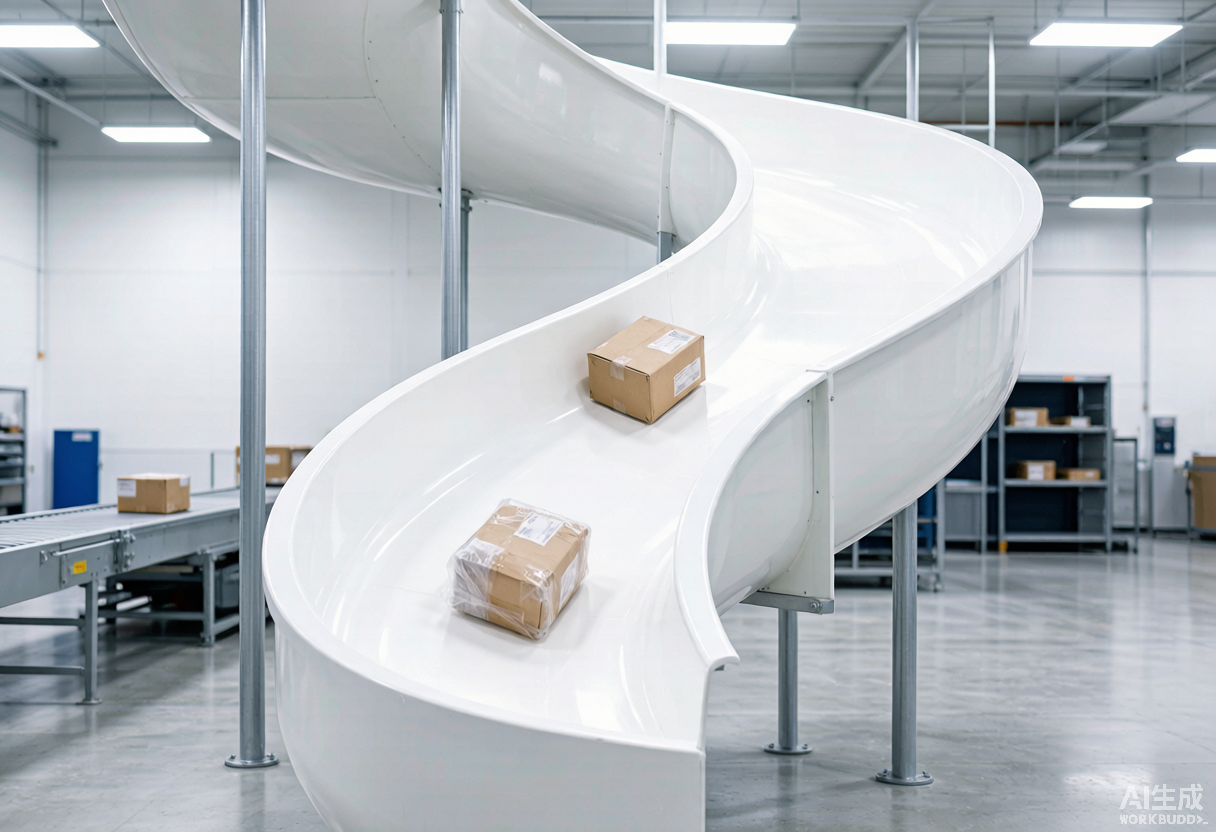
The material of your warehouse chute affects everything from installation cost to lifespan, corrosion resistance, and maintenance. The two most common choices are FRP (fiberglass-reinforced plastic) และ steel — and the right pick depends on what you are moving and where.
Guosheng manufactures chutes in both materials: the ท่อส่งแบบเกลียวทำจาก FRP และ ท่อส่งทำจากเหล็กคาร์บอน, with stainless steel options available across the chute product line. This guide compares the two materials across the factors that matter most.
FRP Chute: Lightweight and Corrosion-Resistant
FRP (glass-reinforced plastic) chutes are made from fiberglass composites that combine strength with light weight. The ท่อส่งแบบเกลียวทำจาก FRP handles 6,000–10,000 parcels per hour with a smooth surface that is gentle on fragile goods.
- Corrosion resistance — ideal for cold chain, pharmaceutical, and food-grade environments
- Lightweight — easier and cheaper to install, less structural support required
- Low maintenance — fewer issues than metal in humid or chemically active environments
- Gentle surface — smooth finish reduces damage to delicate parcels
Steel Chute: Maximum Strength and Durability
Steel chutes, particularly carbon steel, are built for heavy-duty industrial environments. The ท่อส่งทำจากเหล็กคาร์บอน delivers exceptional tensile strength and long service life under continuous, high-volume operation.
- ความแข็งแรง — handles heavy cartons and high-impact loads
- Durability — long service life in demanding industrial workflows
- การปรับแต่ง — surfaces, widths, angles, and interfaces fully customizable
- Proven track record — decades of industrial use
FRP vs Steel Chute: Comparison Table
| เกณฑ์ | FRP Chute | Steel Chute |
|---|---|---|
| Weight | Light | Heavy |
| Corrosion resistance | Excellent | Moderate (carbon steel needs coating) |
| ความแข็งแรง | Good for lightweight-medium parcels | Excellent for heavy loads |
| ค่าใช้จ่ายในการติดตั้ง | Lower (lighter structure) | สูงขึ้น |
| การบำรุงรักษา | ต่ำ | Low, but rust risk in humid areas |
| เหมาะที่สุดสำหรับ | Cold chain, pharma, food, fragile goods | Heavy industrial, high-volume |
วิธีเลือก
- Moving fragile, light, or temperature-sensitive goods in cold chain or pharma? Choose FRP.
- Moving heavy cartons in a demanding industrial environment? Choose carbon steel.
- ต้องการ hygiene-critical or washdown operations? Choose stainless steel.
- Constrained on 结构支撑? FRP的轻量化特性简化了安装过程。.
สรุป
没有唯一的“最佳”滑槽材料——只有最适合您运营的材料。FRP滑槽在耐腐蚀性、轻量化以及对易碎和温度敏感货物的温和处理方面具有优势。钢制滑槽在重工业物流的原始强度和耐用性方面胜出。根据您的包裹特性和环境选择合适的材料,您的滑槽将为您服务多年。.
不确定哪种材料适合? 请咨询国盛工程师 — 我们生产FRP、碳钢和不锈钢材质的滑槽。.
คำถามที่มักถูกถาม
问:什么是FRP滑槽?
答:FRP滑槽是一种由玻璃增强塑料(玻璃纤维)制成的仓库滑道。它具有耐腐蚀、轻量化和表面光滑的特点,非常适合冷链、制药和食品级包裹处理。.
问:FRP滑槽和钢制滑槽哪个更好?
答:这取决于您的运营需求。FRP在耐腐蚀性、轻量化和易碎货物处理方面更优。钢制(碳钢)在重载和工业环境中的最大耐用性方面更优。不锈钢适用于对卫生要求严格的运营场景。.
问:FRP滑槽能否处理高流量?
答:可以。国盛的FRP螺旋滑槽在单层或多层配置下每小时可处理6,000至10,000件包裹,适用于高流量冷链和电商运营。.