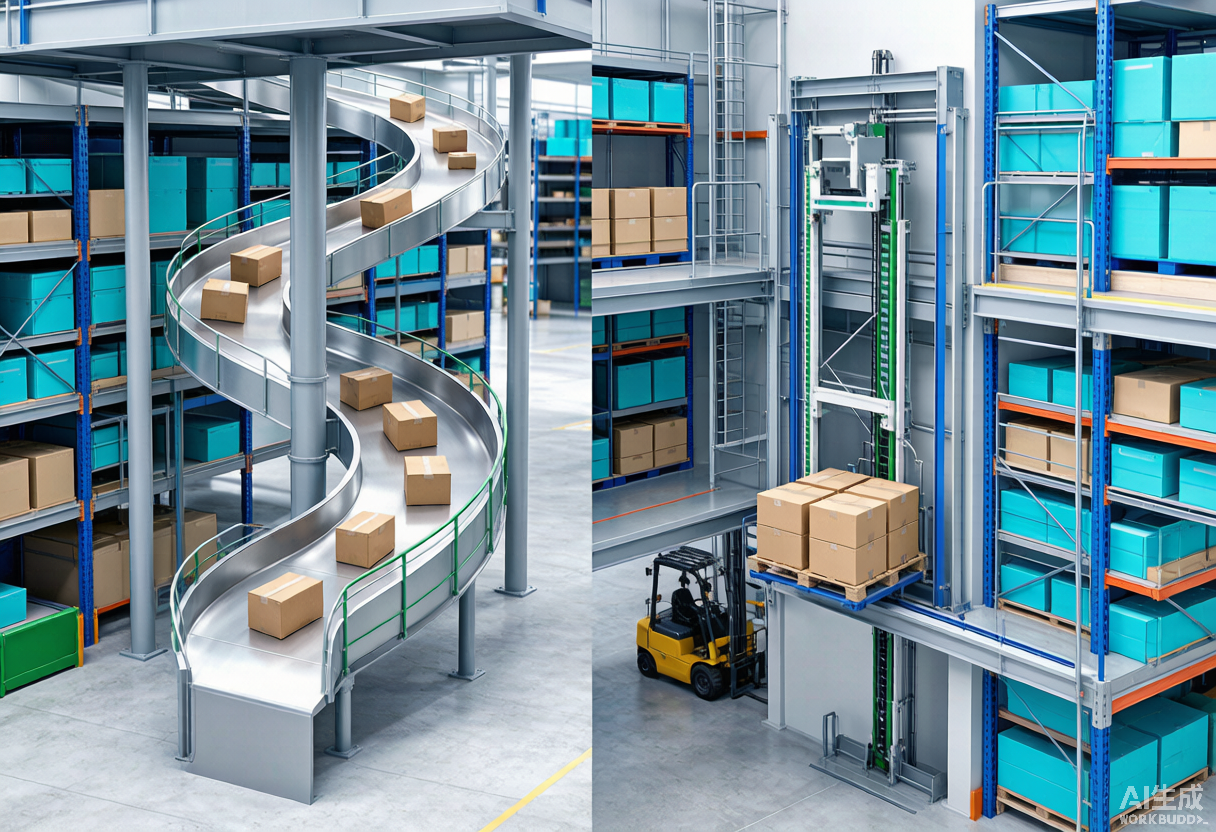
Moving parcels between warehouse levels is one of the most common — and most debated — challenges in facility design. Should you install a спиральный желоб that uses gravity to slide parcels down in a smooth curve, or a powered vertical conveyor that lifts and lowers them continuously? The answer depends on your throughput, parcel mix, floor space, and budget.
In this guide, we compare the two technologies head-to-head using Guangdong Guosheng’s actual product line — spiral chutes on one side and vertical conveyors on the other — so you can make an informed purchasing decision.
What Is a Spiral Chute?
A spiral chute is a gravity-fed slide that wraps around a central axis, allowing parcels to descend multiple levels within a compact footprint. Guosheng manufactures two spiral models with different materials and configurations:
- Спиральный желоб из стеклопластика — glass-reinforced plastic construction for corrosion resistance, ideal for cold chain, pharmaceutical, and food-grade facilities. Handles up to 6,000–10,000 parcels per hour with gentle handling of fragile goods.
- Спиральный желоб для логистики — gravity-fed spiral conveyor in stainless steel, carbon steel, or low-friction materials. Supports up to 6,000–10,000 parcels per hour with optional barcode scanners, RFID tracking, and motorized rollers.
Both models are available in single-tier or multi-tier configurations and require no electricity to operate in their pure gravity form — parcels simply follow the curve of the slide from the upper level to the lower level.
What Is a Vertical Conveyor?
A vertical conveyor is a powered system that mechanically lifts and lowers items between floor levels. Guosheng offers four main types:
- Непрерывный вертикальный конвейер — continuously moves cartons, totes, and parcels between floors for maximum vertical throughput.
- Вертикальный поршневой конвейер (VRC) — a reciprocating lifting platform that safely moves cartons, pallets, and totes between multiple levels.
- Система спирального цепного конвейера — a powered spiral belt that continuously conveys items up or down while saving floor space.
- Вертикальный подъемный конвейер вилочного типа — fork-style loading structure for heavy pallet and carton lifting between levels.
Unlike chutes, vertical conveyors can move goods in both directions — up and down — and can handle significantly heavier loads, including full pallets. They are motor-driven and typically connect directly to upstream and downstream conveyor lines.
Spiral Chute vs Vertical Conveyor: Head-to-Head Comparison
| Критерий | Spiral Chute | Вертикальный конвейер |
|---|---|---|
| Направление | Downward (gravity) | Up and down (powered) |
| Typical capacity | 6,000–10,000 parcels/hr | Depends on model; continuous or batch |
| Energy cost | Near zero (gravity-fed) | Motor-driven, ongoing energy use |
| Грузоподъёмность | Lightweight parcels, cartons | Parcels to full pallets (fork-type/VRC) |
| Площадь занимаемой территории | Compact spiral around one axis | Larger mechanical footprint, some spiral options |
| Gentle handling | Excellent — smooth curved slide | Good — controlled horizontal transfer |
| Техническое обслуживание | Very low, no moving parts in gravity mode | Moderate — motors, chains, drives |
| Стоимость установки | Lower | Выше |
| Идеально подходит для | Downward parcel flow, cold chain, pharma | Upward flow, pallets, heavy loads, bi-directional |
When to Choose a Spiral Chute
A spiral chute is often the smartest choice when your operation matches these conditions:
- You only need downward flow. If parcels arrive on an upper mezzanine and need to reach dispatch or packing on a lower level, gravity does the work for free.
- You handle lightweight to medium parcels. Spiral chutes shine with boxes, cartons, totes, and standard e-commerce parcels.
- You want minimal operating costs. With no motors or drives in pure gravity mode, spiral chutes consume essentially no energy and require very little maintenance.
- Fragile or temperature-sensitive goods. The FRP spiral chute’s smooth, corrosion-resistant surface is ideal for cold chain and pharmaceutical operations where gentle handling matters.
- You have limited space. A spiral wraps vertical movement into a compact footprint without long inclined ramps.
Because Guosheng spiral chutes can be fitted with optional motorized rollers, barcode scanners, and RFID tracking, they can even act as an active part of your automated sorting line — not just a passive slide.
When to Choose a Vertical Conveyor
A vertical conveyor becomes the better option in these scenarios:
- You need upward movement. Chutes only go down. If goods must be lifted to a mezzanine or upper storage level, a powered vertical conveyor is required.
- You move pallets or heavy loads. Fork-type vertical lifts and VRCs handle pallet loads that no chute can carry.
- You need continuous bi-directional flow. A continuous vertical conveyor or spiral chain conveyor maintains steady throughput in both directions, synchronizing with conveyor lines.
- You require integration with automated systems. Vertical conveyors connect naturally to WMS/WCS-controlled conveyor networks for fully automated material flow.
If your operation moves heavy items, needs upward transport, or requires tightly synchronized conveyor integration, the higher upfront and energy cost of a vertical conveyor is justified by its capabilities.
Can You Use Both Together?
In many real-world facilities, the answer is yes — and combining both is often the most cost-effective design. A common hybrid layout:
- Use a вертикальный конвейер to lift empty totes, replenishment stock, or heavy items to upper levels.
- Use a спиральный желоб to return empty containers or send outbound parcels down — capturing gravity flow for free.
This approach keeps powered equipment only where it is truly needed, maximizing energy efficiency and minimizing your total cost of vertical transport.
Decision Checklist
- Do parcels need to go up or down? Up = vertical conveyor; down = either works.
- What is your peak parcel weight? Over ~30 kg or pallets = vertical conveyor.
- How many parcels per hour? Spiral chutes handle 6,000–10,000/hr; match the conveyor model to your rate.
- Is energy efficiency a priority? Gravity chutes win on operating cost.
- Do you need conveyor integration and automation? Vertical conveyors integrate more directly.
- How much floor space is available? Spiral designs are footprint-optimized.
For a deeper look at each product, read our complete guide to the five types of logistics chutes, which covers carbon steel, FRP, spiral, curved, and straight chutes in detail.
Заключение
Both spiral chutes and vertical conveyors have their place in modern warehouse design. Choose a спиральный желоб for low-cost, gravity-fed downward parcel flow in compact spaces — especially in cold chain and pharmaceutical environments. Choose a вертикальный конвейер for powered, bi-directional transport of heavier loads and tight conveyor integration. And for many facilities, the winning strategy is a combination of both.
Not sure which solution fits your operation? Talk to our engineering team — we manufacture both product lines and can recommend the optimal vertical transport layout for your warehouse, free of charge.
Часто задаваемые вопросы
Q: What is the main difference between a spiral chute and a vertical conveyor?
A: A spiral chute is a gravity-fed slide that moves parcels downward only, using no power and offering very low operating cost. A vertical conveyor is a powered system that moves goods up and down, handles heavier loads such as pallets, and integrates more directly with conveyor automation. The choice depends on direction, parcel weight, and budget.
Вопрос: Сколько посылок в час может пропускать спиральный желоб?
A: Guosheng spiral chutes — both the FRP and logistic models — handle up to 6,000 to 10,000 parcels per hour depending on configuration (single-tier or multi-tier) and parcel characteristics. Custom designs can be engineered for higher throughput.
Q: Can a spiral chute move parcels upward?
A: No. In its standard gravity-fed form, a spiral chute only moves parcels downward. For upward movement, you need a powered vertical conveyor such as Guosheng’s continuous vertical conveyor, VRC, spiral chain conveyor, or fork-type lift.
Q: Are spiral chutes suitable for heavy parcels?
A: Spiral chutes are best for lightweight to medium parcels, cartons, and totes. If you handle parcels over roughly 30 kg or full pallets, a vertical conveyor or vertical lift is the more suitable solution.
Q: What is the operating cost difference?
A: In pure gravity mode, a spiral chute consumes no electricity and requires minimal maintenance — the lowest possible operating cost. Vertical conveyors are motor-driven, so they incur ongoing energy consumption and periodic maintenance of drives, chains, and control systems.
Q: Can spiral chutes and vertical conveyors be used together?
A: Yes — combining them is a common and cost-effective design. Use vertical conveyors to lift replenishment stock or heavy items up, and spiral chutes to return empty totes or send outbound parcels down, capturing gravity flow for free.