
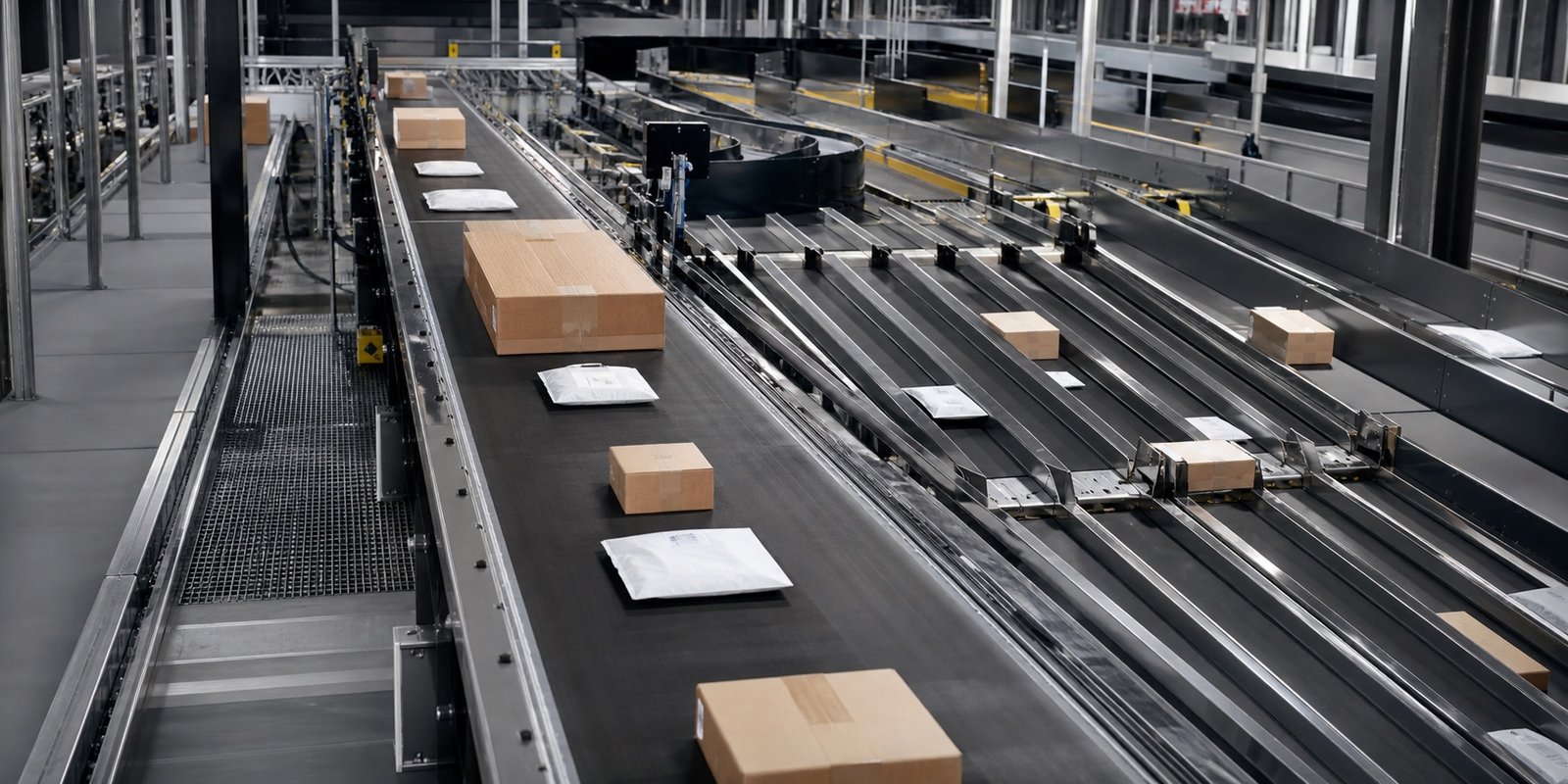
Elegir un clasificador de cinta estrecha is less about finding a single “best” machine and more about matching the sorter to the parcel flow, layout, controls, and operating goals of a facility. For postal, e-commerce, retail, and third-party logistics operations, a narrow belt configuration can provide a compact, modular way to move parcels and direct them toward the correct outbound path.
This guide explains how a narrow belt sorter works, where it fits, what to evaluate before specifying one, and how it compares with other parcel sortation technologies. It is intended as an early planning resource; final equipment selection should be based on measured parcel data, site constraints, operating scenarios, and a detailed engineering review.
What Is a Narrow Belt Sorter?
A narrow belt sorter is a conveyor-based automated sorter built around multiple parallel belt modules. Packages travel on the belt surface while the system identifies each item and diverts it to the required lane or downstream route. The modular arrangement is designed for stable parcel transport and accurate routing in a relatively compact mechanical footprint.
De Guosheng Clasificador de cinta estrecha is intended for parcels, cartons, mailers, and boxed goods in high-density sortation lines. It can be integrated with scanning equipment, PLC controls, WCS, and WMS environments, making it suitable for operations that need the sorter to work as part of a wider material-handling system rather than as an isolated conveyor.
How a Narrow Belt Sorter Works in a Parcel Flow
The sortation sequence normally begins before the narrow belt sorter itself. Items are inducted in a controlled orientation, identified by a barcode or other data source, and assigned a destination by the control system. As a parcel reaches its scheduled diversion point, the sorter uses its belt modules and transfer arrangement to guide the item toward the correct output.
Reliable performance depends on the complete flow around the sorter: induction spacing, readable labels, package stability, destination availability, and downstream accumulation all matter. A well-designed line also confirms that the selected sorter suits the lowest stable package size, the range of parcel bases, and the mix of cartons and soft mailers expected in real operation.
Where Narrow Belt Sorters Fit Best
Narrow belt sorters are commonly considered when an operation handles mixed parcel flows and needs a compact conveyor-based sorting section. Typical environments include postal centers, e-commerce fulfillment facilities, parcel distribution hubs, retail distribution operations, and 3PL warehouses.
They can be particularly useful where the layout needs to connect scanning, routing, and multiple outbound paths without creating an oversized mechanical system. Their modular construction can also make them a practical option when a project requires phased expansion, provided the controls, discharge design, and space plan allow for future growth.
Five Selection Questions to Answer Before You Specify a Sorter
-
.
- What items will be sorted? Record the dimensions, weights, base condition, packaging material, and special handling needs of the smallest and most difficult items, not just the average carton.
- What is the real operating profile? Use hourly arrival patterns, peak periods, destination mix, and recirculation expectations to define the required operating scenario.
- How many destinations are required? The number and arrangement of chutes, conveyors, or workstations affects the sorter layout and the available time for each diversion.
- How will the sorter connect to controls? Confirm the data flow between scanning, PLC logic, WCS, and WMS before selecting interfaces or defining exception handling.
- What happens after the discharge? A successful diversion is only useful when the downstream lane can accept the parcel. Check accumulation, operator access, labeling, and transfer capacity at every output.
.
.
.
.
For a broader project-level decision framework, see our guide on Cómo elegir el sistema de clasificación automática adecuado. It helps connect equipment choice to material characteristics, process targets, and facility constraints.
Narrow Belt Sorter vs. Other Parcel Sortation Options
| Tipo de clasificador | Typical strength | When to evaluate it |
|---|---|---|
| Clasificadora de cinta estrecha | Compact, modular conveyor-based routing for mixed parcels and cartons. | High-density parcel lines that need stable transport and integration with scanning and warehouse controls. |
| Clasificadora de cintas cruzadas | Individual carrier-based handling for varied items and complex destination patterns. | Projects where item handling requirements and the overall sortation design call for carrier-based sorting. |
| Clasificadora de brazo oscilante | Pivoting diversion for a defined parcel flow and route arrangement. | Operations evaluating a mechanical diverter approach for selected parcel sizes and line layouts. |
| Clasificador de ruedas giratorias | Wheel-based transfer and routing for compatible carton and parcel bases. | Conveyor systems where the package base, transfer behavior, and discharge geometry are a strong fit. |
No table replaces a material-flow test. The right option should be selected after reviewing item data, required outputs, available footprint, control architecture, maintenance access, and commissioning support.
Integration: Scanning, PLC, WCS, and WMS
Sortation is a control problem as much as a mechanical problem. A narrow belt sorter needs reliable identification data, clear destination logic, parcel tracking through the line, and a response plan for unreadable labels or blocked outputs. During design, define what system owns each decision: the scanner, PLC, WCS, or WMS.
Reviewing these interfaces early reduces late-stage changes to I/O, routing logic, and exception lanes. It also makes acceptance testing more meaningful because the team can test normal routing, no-read handling, full destinations, restart behavior, and recovery from upstream or downstream interruptions.
Safety and Commissioning Considerations
Guarding, emergency stops, access zones, lockout procedures, and operator training must be engineered for the installed system and local requirements. The U.S. Occupational Safety and Health Administration provides general warehousing safety guidance; project teams should also follow the applicable regulations and site safety process in their own jurisdiction.
Before handover, test representative items across the expected operating conditions. Commissioning should include induction quality, scan-read behavior, destination accuracy, discharge recovery, downstream accumulation, and the operational procedures staff will use when a parcel cannot be automatically routed.
Plan a Narrow Belt Sorter Around the Whole System
A narrow belt sorter can be a strong fit for parcel operations that need compact, modular routing with stable transport and integrated controls. Its value comes from the way it supports the whole line: induction, identification, diversion, discharge, and recovery all need to work together.
Guosheng can help evaluate narrow belt sorter configurations alongside your parcel mix, layout, and automation requirements. Ponte en contacto con nuestro equipo to discuss a project or request an equipment consultation.
Preguntas frecuentes
What can a narrow belt sorter handle?
It is commonly used for parcels, cartons, mailers, and boxed goods. Compatibility should be confirmed against the real dimensions, weights, package bases, and condition of the items in your operation.
Can a narrow belt sorter connect to a warehouse control system?
Yes. A properly engineered project can integrate scanning equipment, PLC controls, WCS, and WMS data. The exact interface and routing logic should be defined during system design.
How do I choose between a narrow belt sorter and a cross-belt sorter?
Compare the parcel mix, required destination pattern, layout, item handling needs, control strategy, and long-term expansion plan. A material-flow review is the best way to determine which technology is appropriate.
What information should I prepare for a sorter quotation?
Provide parcel dimensions and weights, hourly and peak volumes, destination count, layout drawings, upstream and downstream equipment details, scanning requirements, control interfaces, and local safety expectations.