
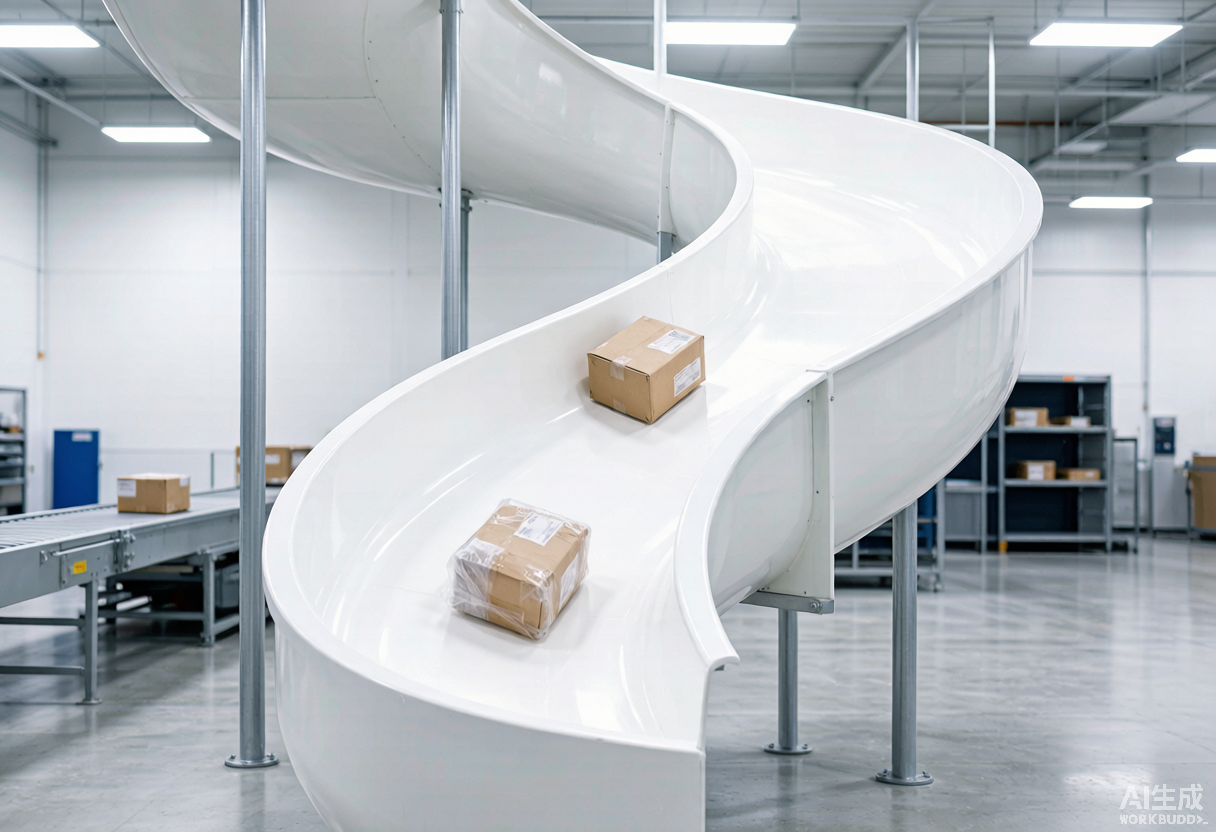
The material of your warehouse chute affects everything from installation cost to lifespan, corrosion resistance, and maintenance. The two most common choices are FRP (fiberglass-reinforced plastic) y steel — and the right pick depends on what you are moving and where.
Guosheng manufactures chutes in both materials: the Tolva en espiral de FRP y el Tolva de acero al carbono, with stainless steel options available across the línea de productos «chute». This guide compares the two materials across the factors that matter most.
FRP Chute: Lightweight and Corrosion-Resistant
FRP (glass-reinforced plastic) chutes are made from fiberglass composites that combine strength with light weight. The Tolva en espiral de FRP handles 6,000–10,000 parcels per hour with a smooth surface that is gentle on fragile goods.
- Corrosion resistance — ideal for cold chain, pharmaceutical, and food-grade environments
- Lightweight — easier and cheaper to install, less structural support required
- Low maintenance — fewer issues than metal in humid or chemically active environments
- Gentle surface — smooth finish reduces damage to delicate parcels
Steel Chute: Maximum Strength and Durability
Steel chutes, particularly carbon steel, are built for heavy-duty industrial environments. The Tolva de acero al carbono delivers exceptional tensile strength and long service life under continuous, high-volume operation.
- Fuerza — handles heavy cartons and high-impact loads
- Durability — long service life in demanding industrial workflows
- Personalización — surfaces, widths, angles, and interfaces fully customizable
- Proven track record — decades of industrial use
FRP vs Steel Chute: Comparison Table
| Criterio | FRP Chute | Steel Chute |
|---|---|---|
| Weight | Light | Heavy |
| Corrosion resistance | Excellent | Moderate (carbon steel needs coating) |
| Fuerza | Good for lightweight-medium parcels | Excellent for heavy loads |
| Coste de instalación | Lower (lighter structure) | Más alto |
| Mantenimiento | Bajo | Low, but rust risk in humid areas |
| Ideal para | Cold chain, pharma, food, fragile goods | Heavy industrial, high-volume |
Cómo elegir
- Moving fragile, light, or temperature-sensitive goods in cold chain or pharma? Choose FRP.
- Moving heavy cartons in a demanding industrial environment? Choose carbon steel.
- Necesidad hygiene-critical or washdown operations? Choose stainless steel.
- Constrained on structural support? FRP’s light weight simplifies installation.
Conclusión
There is no single “best” chute material — only the best material for your operation. FRP chutes win on corrosion resistance, light weight, and gentle handling for fragile and temperature-sensitive goods. Steel chutes win on raw strength and durability for heavy industrial flows. Match the material to your parcel profile and environment, and your chute will serve you for years.
Not sure which material fits? Ask Guosheng’s engineers — we manufacture chutes in FRP, carbon steel, and stainless steel.
Preguntas frecuentes
Q: What is an FRP chute?
A: An FRP chute is a warehouse slide made from glass-reinforced plastic (fiberglass). It offers corrosion resistance, light weight, and a smooth surface, making it ideal for cold chain, pharmaceutical, and food-grade parcel handling.
Q: Which is better, FRP or steel chute?
A: It depends on your operation. FRP is better for corrosion resistance, light weight, and fragile goods. Steel (carbon steel) is better for heavy loads and maximum durability in industrial environments. Stainless steel suits hygiene-critical operations.
Q: Can FRP chutes handle high volumes?
A: Yes. Guosheng’s FRP spiral chute handles 6,000–10,000 parcels per hour in single-tier or multi-tier configurations, making it suitable for high-volume cold chain and e-commerce operations.