
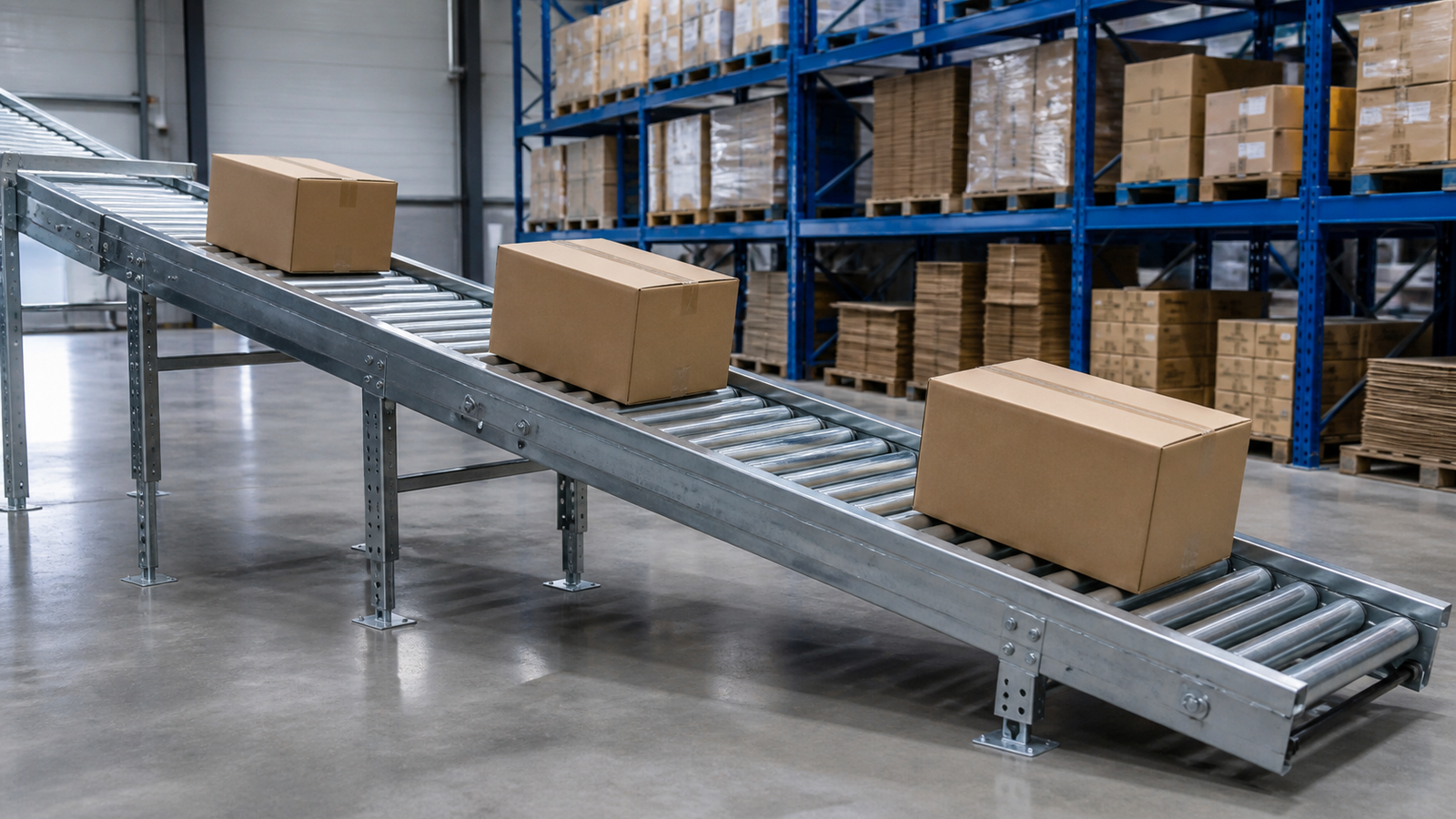
A gravity roller conveyor moves unit loads across free-spinning rollers without a drive motor on every section. In the right application, a small elevation change or a manual push starts the movement, while the rollers support the load and reduce friction. That makes gravity conveying a practical option for simple transfer points, packing areas, dispatch lanes, and low-complexity warehouse flow.
The important qualification is the load itself. Cartons, totes, and stable palletized loads can be good candidates when their bases are rigid and even. Soft bags, very small items, irregular bases, or loads that need precise release timing may require another conveying method. This guide explains how gravity roller conveyors work, where they fit, and what to confirm before requesting a layout.
How a Gravity Roller Conveyor Moves a Load
A gravity roller conveyor has a frame, a series of freely rotating rollers, supports, and usually side guides or end controls where needed. A load rests on several rollers at once. When the conveyor is set on an appropriate decline, gravity provides the force that moves the load forward; on level sections, an operator can position the load manually. The correct layout depends on the load base, weight distribution, roller spacing, surface condition, and the desired flow.
Because there is no powered drive in a basic gravity section, it does not provide positive speed control or automatic accumulation. That is an advantage when the goal is a simple, low-energy transfer, but it is a constraint where consistent release, long level travel, or integration with automated controls is required.
Which Loads Work Best on Gravity Rollers?
Gravity roller conveyors are normally considered for cartons, plastic totes, rigid bins, and stable palletized units with flat or firm bases. The load needs enough contact with the rollers to remain supported and track predictably. A good layout review considers the smallest and largest load, not only the typical one.
- Good candidates: rigid cartons, flat-bottom totes, trays, and stable pallet loads.
- Needs review: lightweight packaging, uneven or flexible bases, very short items, or top-heavy loads.
- Usually unsuitable without an adapted design: loose materials, soft bags, and items that can catch between rollers or lose stable contact.
These are starting points rather than guaranteed rules. Before finalizing a gravity roller conveyor, provide a representative item sample, its base dimensions, weight range, and center-of-gravity information to the engineering team.
Typical Warehouse Applications
Gravity sections are often used where people, processes, or a powered conveyor already create the start and stop points. Common examples include manual packing benches, quality-check stations, order consolidation, truck loading and unloading, and short transfers between work areas. A transportador de rodillos recto is a useful building block for linear routes, while a transportador de rodillos telescópico can help bridge the changing distance between a dock and a vehicle.
For a vertical downward route where floor space is limited, a transportador de rodillos por gravedad en espiral can be evaluated for loads that are suitable for roller contact. The correct configuration still depends on item stability, routing, guarding, and transfer conditions.
When a Powered Roller Conveyor Is the Better Choice
Choose a powered system when the material flow needs controlled speed, travel over level or uphill sections, automatic accumulation, release control, or connection to sensors and system controls. Powered rollers can also be the better option when product variation is wide or when manual assistance would interrupt the process. The right comparison is not simply “lower cost versus higher cost”; it is whether the required level of control matches the process.
For a side-by-side decision framework, read Gravity Roller Conveyor vs Powered Roller Conveyor. Many facilities use both: powered zones where control matters and gravity zones where a simple transfer is enough.
Five Inputs to Confirm Before a Layout Is Drawn
- Perfil de carga: smallest and largest base dimensions, weight range, and whether the base is rigid and flat.
- Flow direction: whether the section is downhill, level with manual assistance, or part of a mixed powered-and-gravity line.
- Route: straight, curved, telescopic, or spiral path, plus available floor space and elevation change.
- Transfers and discharge: how goods enter and leave the section, and where stops, brakes, or speed control may be needed.
- Operating environment: access for operators, side guarding, maintenance space, and applicable local safety requirements.
The deeper pre-RFQ checklist is available in our Gravity Roller Conveyor Design Checklist. It is useful to send that information with a basic floor plan so the proposed system is based on real operating conditions rather than generic dimensions.
Safety and Maintenance Considerations
Even without motors, a gravity conveyor has moving loads, pinch points, and discharge areas that need considered guarding and operating procedures. Inspect rollers, frames, fasteners, supports, guards, and end stops routinely, and keep debris away from the roller path. The ASME B20.1 safety standard overview is a useful reference for conveyor-system safety; the final installation must follow the regulations and site requirements that apply to the project.
Preguntas frecuentes
What is a gravity roller conveyor?
A gravity roller conveyor is an unpowered conveyor section that supports unit loads on free-spinning rollers. Loads move by a controlled decline or manual push instead of a motorized drive.
Can a gravity roller conveyor move pallets?
It can move stable palletized loads when the pallet base, load distribution, roller selection, support structure, and route are designed for the application. Engineering should confirm the configuration before installation.
Does a gravity roller conveyor need electricity?
A basic gravity section does not need electricity to turn the rollers. A larger system may still include adjacent powered zones, sensors, or safety devices depending on the process.
How do I choose between gravity and powered rollers?
Choose gravity when a stable load can move through a simple route with little or no speed control. Choose powered rollers when the process needs controlled movement, accumulation, automation, or uphill and level travel.
Plan the Right Roller Conveyor System
A gravity roller conveyor is straightforward only when the load and route are straightforward. Share your item profile, flow direction, floor plan, and throughput goal with Guosheng for a practical layout review. You can also explore the full Gama de productos de transportadores de rodillos for straight, telescopic, spiral, and powered options.