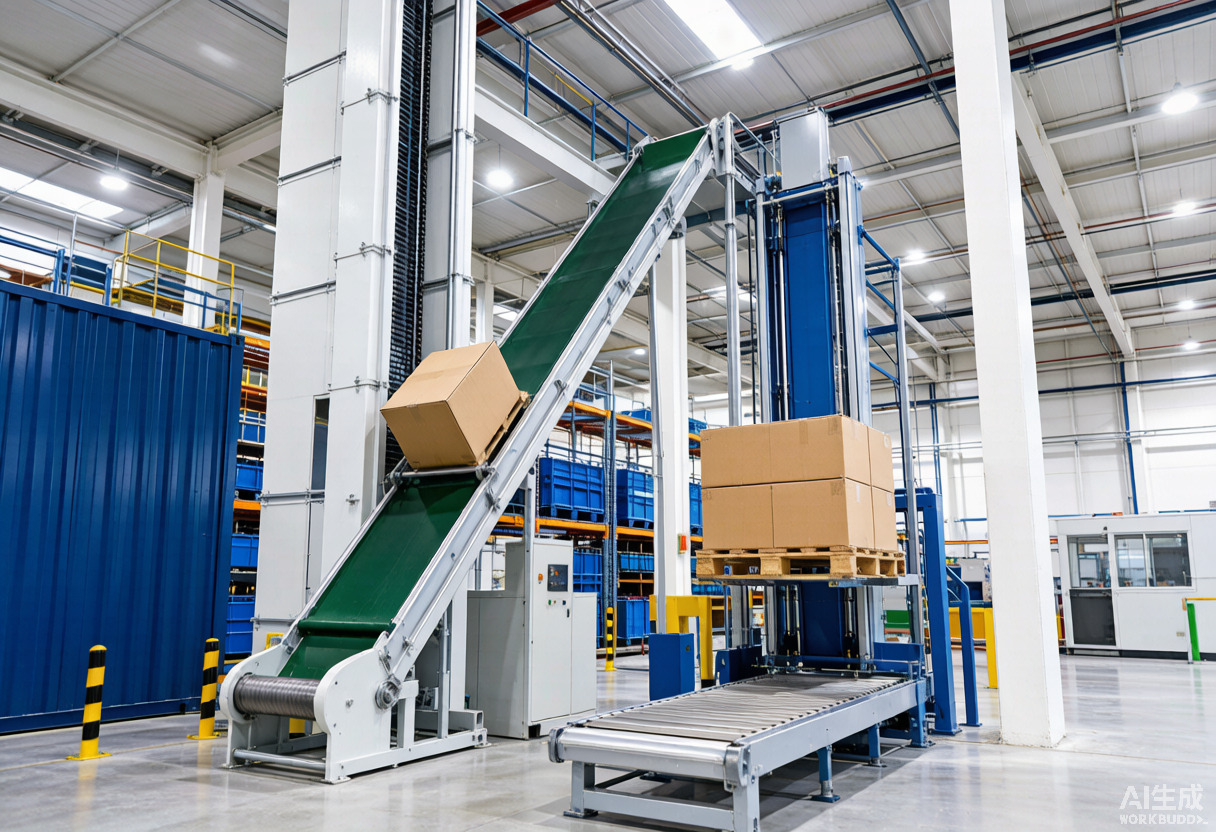
Moving goods between warehouse levels is a decision that comes down to one question: which vertical lift conveyor type fits your load, your flow, and your space? There is no single best answer — the four main types each solve a different combination of these constraints.
This guide compares Guosheng’s four vertical product families so you can shortlist the right one, then ask the right questions at the layout review. Technical comparisons here are directional; confirm final speed, capacity, and lift-height figures with engineering.
What Vertical Transfer Solves
A vertical lift conveyor moves cartons, totes, pallets, and packages between floor levels automatically — replacing forklift trips, manual carrying, and long ramps. It is the core of multi-level warehouse automation, connecting mezzanines, elevated process lines, and dock heights to the main floor.
Comparison of the Four Types
| Type | Movement Mode | Typical Items | Layout Constraint | Best-Fit Question |
|---|---|---|---|---|
| Kontinuierlicher Vertikalförderer | Kontinuierlicher Datenstrom | Kartons, Transportkisten, Pakete | Kompakte vertikale Schleife | Do you need high, steady throughput of lighter goods? |
| Vertikaler Hubförderer (VRC) | Reciprocating platform | Kartons, Paletten, Transportbehälter | Vertikaler Schacht + Plattform | Do you move heavy loads or pallets in batches? |
| Fork Type Vertical Lift | Fork-style loading | Pallets, cartons | Fork carriage structure | Do you need automated pallet handling between levels? |
| Spiralförderer | Continuous spiral path | Cartons, packages, totes | Space-saving spiral | Is floor space tight and flow continuous? |
1. Kontinuierlicher Vertikalförderer
Die Kontinuierlicher Vertikalförderer moves cartons, totes, and parcels between floors in a continuous stream, maximizing throughput with minimal gaps. Its compact loop suits high-volume logistics centers and e-commerce fulfillment, with adjustable speed and carbon steel or stainless steel frames.
2. Vertikaler Hubförderer (VRC)
Die Vertikaler Hubförderer uses a reciprocating lifting platform to move cartons, pallets, and totes safely between multiple levels. It is the workhorse of industrial vertical lifting — robust, safety-guarded, and suited to heavier batch loads.
3. Fork Type Vertical Lift Conveyor
Die Vertikalförderer mit Gabelkonstruktion uses a fork-style loading structure to transfer pallets and heavy cartons between levels — the standard solution for automated pallet handling in warehouses, manufacturing, and distribution.
4. Spiral Chain Conveyor System
Die Spiralförmiges Kettenfördersystem conveys cartons and packages continuously up or down along a spiral path, saving valuable floor space in congested facilities and food production lines. It is the compact footprint option among the four types.
Questions to Send Before a Layout Review
- What is the heaviest item and largest footprint the lift must carry?
- Is flow continuous (many items per hour) or batch (pallets, infrequent loads)?
- What elevation range must the lift bridge, and what is the available shaft/floor opening?
- Does the lift need to integrate with upstream and downstream conveyors, and with your WMS/WCS?
- What safety guarding, interlocks, and access requirements apply at your site?
Fazit
Continuous vertical conveyors suit steady high-volume flow of lighter goods; VRCs and fork-type lifts handle heavier loads and pallets; spiral chain conveyors save floor space. Match the movement mode to your item type and layout, and you will shortlist the right vertical lift conveyor quickly. For the broader picture, see the Leitfaden für Vertikalfördersysteme and the full vertical conveyor product line.
Need to confirm the right type? Send your load and flow details to Guosheng, and our engineers will recommend the vertical lift conveyor type and configuration for your layout review.
Häufig gestellte Fragen
Q: What are the main types of vertical lift conveyors?
A: The main types are continuous vertical conveyors (steady stream of lighter goods), vertical reciprocating conveyors or VRCs (reciprocating platform for heavier batch loads), fork-type vertical lifts (automated pallet handling), and spiral chain conveyors (space-saving continuous spiral flow).
Q: Which vertical lift conveyor is best for pallets?
A: Fork-type vertical lifts and VRCs are the typical choices for pallets, offering fork or platform structures designed for heavy palletized loads between levels.
F: Was ist der Unterschied zwischen einem VRC und einem kontinuierlichen Vertikalförderer?
A: A VRC moves loads in batches on a reciprocating platform, handling heavier items like pallets. A continuous vertical conveyor moves items in a continuous stream, prioritizing throughput of lighter cartons and totes.